

Originally published: June 2026
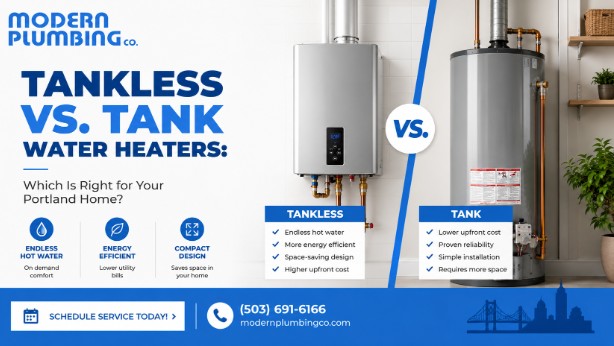
A tank water heater costs less upfront and suits most Portland households with moderate hot water use, while a tankless water heater costs more to install but lasts roughly twice as long and uses less energy.
Portland’s Bull Run watershed water is unusually soft, which shifts the maintenance math for both systems away from the mineral-scale concerns homeowners read about in most national guides.
The choice comes down to upfront budget, household hot water demand, and how long the household plans to stay in the home. The sections below cover Portland-specific costs, the soft-water factor that changes tank versus tankless maintenance, and the rebates currently available for each option.
Schedule a free water heater consultation with Modern Plumbing — serving Portland since 1959, four generations of the same family.
A tank water heater is a storage system that heats and continuously holds 30 to 80 gallons of water at a set temperature, while a tankless water heater heats water on demand as it flows through the unit, with no standing reserve.
The tank design means standby heat loss — energy spent reheating stored water around the clock — while the tankless design eliminates that loss but heats water only when a tap is open.
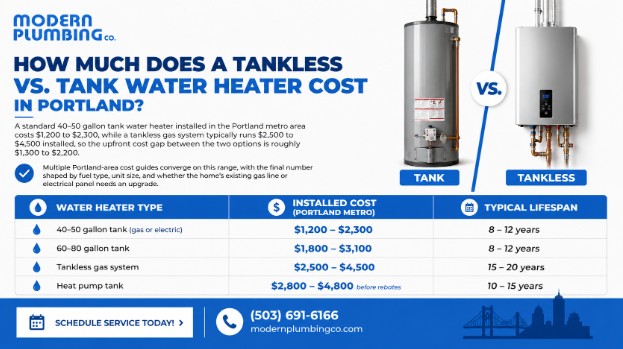
A standard 40–50 gallon tank water heater installed in the Portland metro area costs $1,200 to $2,300, while a tankless gas system typically runs $2,500 to $4,500 installed, so the upfront cost gap between the two options is roughly $1,300 to $2,200.
Multiple Portland-area cost guides converge on this range, with the final number shaped by fuel type, unit size, and whether the home’s existing gas line or electrical panel needs an upgrade.
| Water Heater Type | Installed Cost (Portland Metro) | Typical Lifespan |
| 40–50 gallon tank (gas or electric) | $1,200–$2,300 | 8–12 years |
| 60–80 gallon tank | $1,800–$3,100 | 8–12 years |
| Tankless gas system | $2,500–$4,500 | 15–20 years |
| Heat pump tank | $2,800–$4,800 before rebates | 10–15 years |
A tank-to-tank swap usually completes in a few hours because the existing connections already match the new unit, so labor cost stays on the lower end of the tank range.
A tank-to-tankless conversion often takes a full day, since it requires new venting and, in many homes, a larger gas line, which is the main reason tankless installation costs more than the unit price alone suggests.
If you’re ready to get started, call us now!
Portland’s municipal water, drawn primarily from the Bull Run Watershed, is unusually soft by national standards, which reduces the mineral scale buildup that shortens water heater life in most US cities — but soft water creates a different problem that most national comparisons never mention.
Low mineral content accelerates the depletion of the sacrificial anode rod inside a tank water heater, the component that protects the steel tank from corrosion, so Portland tank owners face an anode-rod replacement need that homeowners in hard-water cities rarely encounter on the same timeline.
Tankless systems sidestep the anode rod issue entirely since they have no tank to protect, but they aren’t maintenance-free under Bull Run water either.
Trace minerals and naturally occurring sediment from the watershed still accumulate inside a tankless unit’s heat exchanger over time, so annual descaling remains necessary even though Portland’s water is gentler on tankless components than hard water would be.
| Factor | Tank Water Heater | Tankless Water Heater |
| Bull Run soft water effect | Less tank scale, faster anode rod depletion | Less heat-exchanger scale, but not maintenance-free |
| Required annual maintenance | Anode rod inspection, sediment flush | Descaling, filter cleaning |
| Risk if maintenance is skipped | Accelerated tank corrosion, early failure | Reduced efficiency, error codes |
Here’s that section converted to a pros/cons table, keeping the same facts and the answer-first paragraph above it per the SOP’s table rule (lead with a tight paragraph, let the table carry the detail).
A tankless water heater delivers continuous hot water and uses energy only on demand, so a household never runs out mid-shower, but the higher upfront cost and installation complexity make it a bigger investment than a like-for-like tank replacement.
| Pros | Cons |
| Continuous hot water with no risk of running out mid-shower | Higher upfront equipment and installation costs than a tank |
| Uses 24–34% less energy than a comparable tank system by skipping standby heat loss | Installation often requires new venting or a larger gas line |
| 15–20 year lifespan, roughly double a standard tank | A single unit can hit a flow-rate bottleneck with several fixtures running at once |
| Compact, wall-mounted design frees up floor space | Households of four or more may need a second unit or a higher-capacity model |
A single tankless unit can struggle to keep pace with several simultaneous high-demand fixtures — a shower, a dishwasher, and a washing machine running at once — in a household with four or more residents, so larger homes sometimes need a second unit or a higher-capacity model to avoid a flow-rate bottleneck.
A tank water heater costs less to buy and install, and a like-for-like replacement is usually finished within a few hours since no new venting or gas line work is required. A tank’s stored reserve also delivers a higher flow rate under simultaneous demand, so a household running a shower, a dishwasher, and a washing machine at the same time draws from the tank without the flow limits a tankless unit can hit.
The tradeoffs show up over the long run rather than at installation. A tank’s standby heat loss keeps the unit drawing energy around the clock, and its 8–12 year lifespan means a Portland homeowner will likely replace a tank system once or twice in the time a single tankless unit would last.
If you’re ready to get started, call us now!
NW Natural and Energy Trust of Oregon together offer a $400 cash incentive for existing NW Natural gas customers who replace a natural gas tank water heater with a qualifying natural gas tankless unit, available through August 31, 2026.
Energy Trust of Oregon separately offers a $700 incentive on qualifying heat pump tank water heaters, available to households served by Portland General Electric, Pacific Power, NW Natural, Cascade Natural Gas, or Avista.
Eligibility for either program depends on the specific unit’s efficiency rating and the household’s utility provider, so confirming a model qualifies before purchase prevents installing a unit that misses the rebate.
The federal Section 25C tax credit, which previously applied to qualifying water heaters, expired on December 31, 2025, making these Oregon- and utility-funded incentives the primary savings path for a 2026 installation.
A tankless system is a good fit for a household planning to stay in the home for 7 or more years, prioritizing space savings, and willing to pay more upfront for a 15–20-year lifespan.
A tank system is a good fit for a household that wants the lowest upfront cost, needs a fast like-for-like replacement, or runs several hot water fixtures simultaneously and needs the higher flow rate a tank provides.
| Choose Tankless If You… | Choose Tank If You… |
| Plan to stay in the home 7+ years | Want the lowest upfront cost |
| Want to free up floor space | Need a fast, simple replacement |
| Have moderate, sequential hot water use | Run several fixtures simultaneously |
| Can accommodate venting or gas line upgrades | Have an existing tank setup already in place |
A Modern Plumbing technician evaluates household size, peak hot water demand, and the home’s existing gas or electrical capacity during an in-home visit, so the recommendation reflects the specific property rather than a generic rule of thumb.
Is a tankless water heater worth it in Portland?
A tankless water heater is worth the higher upfront cost for a household planning to stay for 7 or more years, since its 15–20-year lifespan and 24–34% lower energy use typically offset the installation premium. Households moving sooner often see better value from a tank replacement instead.
Does Portland’s soft water mean tankless units need less maintenance?
Portland’s soft Bull Run water reduces scale buildup compared to hard-water cities, but tankless units still need annual descaling to clear trace minerals and sediment from the heat exchanger. Skipping this maintenance reduces efficiency and can trigger error codes over time.
Why does my Portland water heater’s anode rod wear out fast?
Bull Run water’s low mineral content accelerates anode rod depletion, since the rod’s sacrificial corrosion protection works differently in soft water than in mineral-rich hard water. Tank water heaters in Portland often need anode rod replacement sooner than they would in a hard-water city.
How long does a tankless water heater last compared to a tank?
A tankless water heater typically lasts 15 to 20 years with annual maintenance, roughly twice the 8 to 12-year lifespan of a standard tank water heater. This longer lifespan is a major factor in the long-term cost comparison between the two systems.
How much more does a tankless water heater cost than a tank in Portland?
A tankless gas system installed in the Portland metro area costs $2,500 to $4,500, compared to $1,200 to $2,300 for a standard 40–50 gallon tank. The gap reflects both higher equipment cost and the venting or gas line work a tankless conversion often requires.
Can a tankless water heater keep up with a large family’s hot water demand? A single tankless unit can struggle when several high-demand fixtures run simultaneously in a household of four or more people, creating a flow-rate bottleneck. A correctly sized unit, or a second unit for larger homes, resolves this limitation.
What rebates are available for switching from a tank to a tankless system in Oregon?
NW Natural offers a $400 cash incentive through Energy Trust of Oregon for existing gas customers who convert a tank water heater to a qualifying tankless unit, available through August 31, 2026. Eligibility depends on the specific model’s efficiency rating.
Does switching to a tankless water heater require new gas lines or electrical work?
A tank-to-tankless conversion often requires a larger gas line or, for electric tankless units, additional electrical capacity, since tankless systems demand more instantaneous power than a tank. A technician confirms this during an in-home assessment before installation.
Is a tank water heater a bad choice if I’m staying in my home long-term?
A tank water heater works for any timeline, but a household that stays 7 or more years typically recovers more value from a tankless system’s lower operating costs and longer lifespan. The right choice still depends on the upfront budget and household hot water demand.
How often should a tankless water heater be descaled in Portland?
Annual descaling is recommended for tankless units in Portland, even with the area’s soft Bull Run water, since trace minerals and sediment still accumulate in the heat exchanger over time. Skipping this maintenance shortens the unit’s effective lifespan.
Get a free tank vs. tankless consultation from a Modern Plumbing technician — straight comparison, honest pricing, no pressure either direction.
Quick Links
Plumbing Services
SW Washington Service Areas
Oregon Service Areas