

Originally published: August 2026

Bull Run water — the surface-water source supplying most of the Portland metro area — is naturally soft and low in dissolved minerals, a chemistry profile that national research associates with a specific corrosion pattern in copper pipe.
Portland has adjusted its water chemistry for corrosion control since 1997 and substantially upgraded the treatment in April 2022.
Understanding the treatment timeline — and what it does and doesn’t tell a building owner about a specific property — helps make sense of pinhole leak repair calls tied to older copper plumbing in the city.
Concealed pinhole leaks in copper pipe can go unnoticed for some time. Modern Plumbing PDX inspects copper supply lines and diagnoses pinhole leaks — request an inspection.
Bull Run water is a surface-water supply drawn from a protected watershed east of Portland, and it’s naturally soft — low in dissolved minerals compared to groundwater sources.
Soft water isn’t a quality problem in the way people usually think about water quality; it doesn’t leave scale or mineral buildup the way hard water does.
But that absence of minerals matters specifically for plumbing: mineral content in water contributes to a thin layer that can form on the interior of metal pipes, and soft water has less of that effect, leaving pipe walls more directly exposed to the water passing through them.
Portland has adjusted water chemistry for corrosion control since 1997. Under that original program, and before the city’s 2022 treatment upgrade, treated Bull Run water reached customers at a pH of 8.2.
That’s the relevant pre-upgrade figure — it describes water already under Portland’s corrosion control program, not untreated source water.
If you’re ready to get started, call us now!
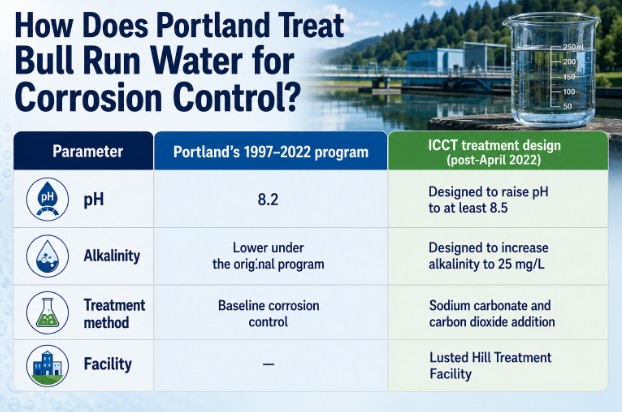
Portland has provided corrosion control treatment since 1997, adjusting water chemistry specifically to reduce the amount of lead and other metals that leach from home and building plumbing into drinking water.
The city significantly upgraded that treatment with the Improved Corrosion Control Treatment (ICCT) project, brought online in April 2022 at the Water Bureau’s Lusted Hill facility.
The upgrade uses two food-and-beverage-grade substances — sodium carbonate and carbon dioxide — and is designed to raise both pH and alkalinity beyond the prior program’s levels.
| Parameter | Portland’s 1997–2022 program | ICCT treatment design (post-April 2022) |
| pH | 8.2 | Designed to raise pH to at least 8.5 |
| Alkalinity | Lower under the original program | Designed to increase alkalinity to 25 mg/L |
| Treatment method | Baseline corrosion control | Sodium carbonate and carbon dioxide addition |
| Facility | — | Lusted Hill Treatment Facility |
These figures describe what the ICCT treatment process is designed to achieve, per Portland Water Bureau’s own program description — not a claim that every sample at every point in the distribution system measures exactly 25 mg/L at all times.
Portland Water Bureau states that lead is rarely found in the city’s source water, and the city has no known lead service lines.
The corrosion control program exists specifically to limit how much metal — including lead — leaches out of building-side plumbing and fixtures as water passes through them, not to address contamination in the water itself.
If you’re ready to get started, call us now!
Soft water with high pH and low alkalinity is a documented factor in a specific failure pattern in copper pipe called pitting corrosion, which produces small, localized pinhole leaks rather than a single obvious break.
This research is national — the EPA has cataloged it in its own science record on pitting corrosion of copper in waters with high pH and low alkalinity — and it identifies water chemistry as one documented contributor to pitting, alongside other variables such as water velocity, disinfectant type, and installation quality.
It isn’t a Portland-specific study, and it doesn’t establish that every case of copper pitting in the city traces to water chemistry alone.
Pinhole leaks are difficult to catch early because they’re small and often hidden inside a wall or ceiling cavity.
A concealed leak can go unnoticed for some time before it shows up as a damp spot, a mineral stain on a fitting, or a change in the water bill, and the longer it goes undetected, the greater the risk of water damage or mold growth in surrounding materials.
Pipe age and installation era are a reasonable starting point for prioritizing which buildings to inspect first, since a copper system installed before Portland’s 2022 treatment upgrade has spent more of its service life under the prior water chemistry.
That’s one input among several a professional inspection weighs — not a standalone predictor that older copper is failing or that a specific leak is caused by water chemistry rather than another factor, such as installation quality or localized plumbing conditions.
Modern Plumbing PDX inspects copper supply lines and handles pinhole leak repairs and, where a system shows multiple failure points, full repiping — schedule an assessment.
A few signs are worth noting, though none confirms pitting corrosion on its own: small, slow leaks that appear at seemingly random points along a copper line rather than at a single joint or fitting; green or blue-green staining near a leak point, a byproduct associated with copper corrosion; and a gradual, unexplained rise in water usage without an obvious source.
Copper leaks can also stem from causes unrelated to water chemistry — physical damage, a poor original joint, or external corrosion from contact with another material — which is part of why a professional inspection, rather than the symptoms alone, is what actually distinguishes the cause.
Bull Run water’s natural softness is a documented factor in copper pitting corrosion under certain pH and alkalinity conditions, and Portland’s corrosion control program — first implemented in 1997, then substantially upgraded in 2022 — has addressed this chemistry at the treatment plant level.
Pipe age is a reasonable factor for prioritizing which buildings to inspect, but it’s one input alongside others, not a standalone diagnosis.
An inspection is what actually confirms whether a specific building’s copper system shows signs of pitting.
A leak already visible has typically been developing for a while before it surfaced. Modern Plumbing PDX inspects copper systems and repairs pitting-related leaks — get an inspection.
Why is Bull Run water associated with copper pitting corrosion?
Bull Run water is naturally soft and low in minerals. National research the EPA has cataloged identifies high-pH, low-alkalinity water as a documented factor in copper pitting corrosion, though water chemistry is one contributor among several, not the sole cause of every case.
When did Portland improve its corrosion control treatment?
Portland has adjusted water chemistry for corrosion control since 1997. The city completed a significant upgrade, the Improved Corrosion Control Treatment project, in April 2022, designed to raise the pH of treated water from 8.2 to at least 8.5 and its alkalinity to 25 mg/L.
Does Bull Run water contain lead?
Portland Water Bureau states that lead is rarely found in the source water, and the city has no known lead service lines. The remaining lead exposure risk in Portland comes from corrosion of lead-containing materials within building plumbing and fixtures, not from the source water itself.
What is a pinhole leak and why does it matter for commercial buildings?
A pinhole leak is a small, localized breach in copper pipe, commonly caused by pitting corrosion. It often goes undetected because it’s hidden inside a wall or ceiling, allowing water damage or mold to develop before the leak is discovered.
Are older copper systems always more likely to develop pitting?
Installation era is a reasonable factor for prioritizing an inspection, since a system installed before Portland’s 2022 treatment upgrade spent more of its service life under the prior water chemistry. It’s one input among several, though — installation quality, water velocity, and other local conditions also affect whether a system develops pitting.
How can a business tell if a leak is related to water chemistry versus another cause?
Small, scattered leak points along a copper line and green or blue-green staining are signs commonly associated with pitting corrosion, but copper leaks can also come from physical damage or a poor original joint. A professional inspection is what actually distinguishes the cause.
Quick Links
Plumbing Services
SW Washington Service Areas
Oregon Service Areas