

Originally published: August 2026
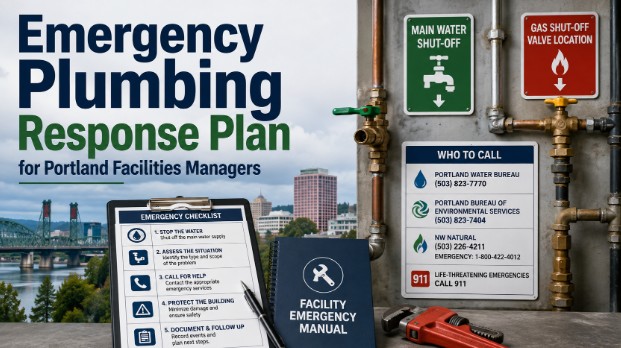
This is a printable reference protocol for Portland-area facilities managers responding to a plumbing emergency— such as a burst pipe, a sewer backup, or a suspected gas leak.
Post it near a utility room or include it in a building’s emergency binder. Each section covers the immediate action sequence and the correct number to call, based on guidance from the Portland Water Bureau, Portland BES, and NW Natural.
Locate and label the building’s main water shutoff valve and the water heater’s dedicated shutoff now — not during an emergency — and confirm which staff members know these locations.
Also note the location of the gas meter for general facility awareness. That said, knowing where the gas shutoff is and approaching it during a suspected active leak are two different things: if gas is actually leaking, the correct response is to evacuate, not to go looking for the meter — see the gas leak protocol below.
Keeping this protocol posted where staff can find it, along with a simple shutoff-location map, reduces the time spent searching during an actual event.
| Emergency Type | Key Signs |
| Burst or leaking pipe | Water flowing or spraying, flooding, a sudden drop in water pressure |
| Sewer backup | Sewage or wastewater backing up through a drain, toilet, or floor drain; sewage odor |
| Suspected gas leak | Rotten-egg smell, a hissing sound near gas lines or appliances |
| Water main break (city-side) | Water bubbling up from the street or sidewalk, ground buckling |
If you’re ready to get started, call us now!
This sequence follows Portland Water Bureau’s own published guidance. If the shutoff valve can’t be located or reached, call the Water Bureau’s 24-hour emergency dispatch line to request an emergency shutoff — though the Bureau notes that during high-volume events (storms, widespread freezing), response times to that line can be longer than usual.
Who’s responsible for the repair? Per the Portland Water Bureau, the Bureau owns and maintains the water infrastructure up to and including the water meter.
Repairing a broken pipe on the customer’s side of the meter — which covers all interior building plumbing essentially — is the property owner’s responsibility. A break at or before the meter is the city’s responsibility.
If the leak appears to be a water main break — water surfacing from the street, ground buckling near the property — report it directly to the Water Bureau’s emergency line rather than treating it as an interior plumbing issue.
Who’s responsible for the repair? Per Portland BES: the pipe connecting a building to the sewer is called the “lateral.” The property owner maintains the portion of the lateral running from the building to the curb.
The city maintains the “branch” — the portion from the curb to the main sewer line in the street. A plumber’s findings determine which segment is affected and who’s responsible for repair.
Portland BES’s own guidance recommends calling a plumber first to investigate the cause of a backup inside a building, before assuming the city’s branch or main is involved.
This sequence follows NW Natural’s official protocol: evacuate first, call from outside, never attempt to locate or stop a suspected gas leak without trained personnel. This is a stricter, faster-priority response than any of the water or sewer steps above — there is no diagnostic step before evacuating.
If you’re ready to get started, call us now!
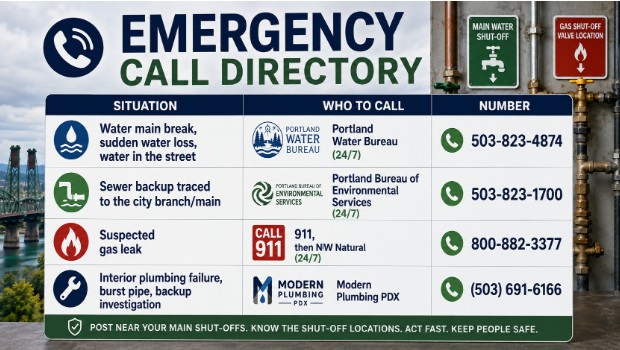
| Situation | Who to Call | Number |
| Water main break, sudden water loss, water in the street | Portland Water Bureau (24/7) | 503-823-4874 |
| Sewer backup traced to the city branch/main | Portland Bureau of Environmental Services (24/7) | 503-823-1700 |
| Suspected gas leak | 911, then NW Natural (24/7) | 800-882-3377 |
| Interior plumbing failure, burst pipe, backup investigation | Modern Plumbing PDX | (503) 691-6166 |
Contact Modern Plumbing PDX for interior plumbing repair.
Photograph or video the affected area before cleanup begins, and keep a written record of when the issue was noticed and what steps were taken.
Get a written report from the plumber identifying the cause — that report is what determines whether repair responsibility falls to the property or to the city.
If the cause is traced to city-owned infrastructure — water infrastructure up to and including the meter, or the sewer branch beyond the curb — a property damage claim against the city generally must be submitted in writing within 180 days of the incident, per City of Portland Risk Management’s claim process, and may require receipts, repair estimates, photos, or an itemized list of damages.
Filing a claim starts an investigation — it does not by itself establish that the city is liable for the damage.
Who is responsible for repairing a burst pipe — the property or the city?
The Portland Water Bureau owns and maintains water infrastructure up to and including the meter. Repairing a broken pipe on the customer’s side of the meter — which covers virtually all interior plumbing in the building — is the property owner’s responsibility.
Should a facilities manager call a plumber or the city first for a sewer backup?
Call a plumber first. The lateral connecting the building to the sewer is the property owner’s responsibility for the portion running to the curb. A plumber’s findings determine whether the city’s branch or main is involved.
What should never be done during a suspected gas leak?
Never search for the source, operate a light switch, or use a phone inside or near the affected area. Leave the building immediately and call 911 and NW Natural from a safe distance outside. Knowing where the gas shutoff is for general preparedness is different from approaching it during an active suspected leak.
Does filing a claim with the city guarantee reimbursement for damage?
No. Filing a written claim within 180 days starts an investigation by City Risk Management. The claim must be supported with documentation such as photos, receipts, or repair estimates, and the city determines liability during that review.
Who should a facilities manager call for interior plumbing repairs after an emergency has been contained?
Modern Plumbing PDX handles interior plumbing repair — burst pipes, water heater failures, and sewer backups traced to the building’s own lateral — at (503) 691-6166.
Quick Links
Plumbing Services
SW Washington Service Areas
Oregon Service Areas