

Originally published: February 2022 | Updated: June 2026
Retail stores in Portland require commercial plumbing systems that protect inventory, maintain ADA-compliant public restrooms, and pass PP&D inspections under Portland City Code Chapter 25.05.
The 2023 Oregon Plumbing Specialty Code (OPSC) governs all retail plumbing installations, alterations, and repairs statewide through September 30, 2026.
Only a licensed Oregon journeyman plumber may perform permitted plumbing work in a retail building under ORS 693.020(2).
A single pipe failure during business hours damages inventory and forces closure. Modern Plumbing handles retail plumbing permits, ADA fixtures, and emergency repairs across Portland. Schedule your retail plumbing consultation.
A commercial plumber serving Portland retail stores handles every water, waste, and fixture system that keeps the store operational and code-compliant — from public restroom plumbing visible to customers to concealed supply lines, drain-waste-vent piping, and backflow prevention assemblies that protect the building and the city’s public water supply.
Hot and cold water supply lines serve public restrooms, employee break rooms, and any point-of-sale areas with sinks. The Oregon Structural Specialty Code determines pipe sizing based on the building’s fixture count and occupancy classification.
Undersized supply lines cause pressure drops during peak hours, affecting restroom fixture performance and the customer experience.
Drain-waste-vent piping connects restroom fixtures, floor drains, and break room sinks to the building sewer lateral. Proper trap seals, vent piping, and pipe slope prevent backups during peak business hours.
A DWV system that lacks adequate venting results in slow drains, gurgling fixtures, and sewer gas odors reaching the sales floor.
Water heater systems deliver tempered water to public handwashing fixtures at 100°F–110°F. Retail buildings with employee kitchens or break rooms require a separate supply capable of delivering at higher temperatures.
A failed water heater results in no hot water at public handwashing fixtures — a health code violation under Oregon’s commercial building standards that requires immediate correction.
Backflow prevention assemblies protect the public water supply at every cross-connection point in the retail building. Portland requires assemblies on retail buildings with fire suppression systems, irrigation connections, or HVAC boiler makeup water lines connecting to potable water.
The Portland Water Bureau mandates annual testing and can restrict water service for buildings operating with expired certifications.
Floor drains in storage and loading areas protect inventory from standing water caused by deliveries, cleaning, or minor leaks. Each floor drain routes drainage to the building’s sanitary or storm sewer connection, depending on the discharge type.
Missing or clogged floor drains turn a minor leak into merchandise damage that spreads across the storage area before staff discover the problem.
If you’re ready to get started, call us now!
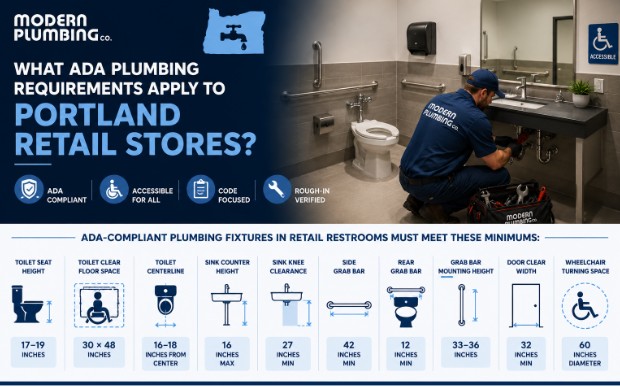
Every retail store open to the public in Portland must meet the 2010 ADA Standards for Accessible Design under Title III. Public restrooms in retail buildings require specific toilet heights, sink clearances, grab bar placements, and wheelchair turning spaces that a licensed plumber must verify during rough-in — before walls close and corrections become demolition work.
ADA-compliant plumbing fixtures in retail restrooms must meet these minimums:
| Fixture Element | ADA Requirement | Measurement |
| Toilet seat height | Floor to seat top | 17–19 inches |
| Toilet clear floor space | Minimum unobstructed area | 30 × 48 inches |
| Toilet centerline | Distance from the side wall | 16–18 inches from center |
| Sink counter height | Maximum | 34 inches |
| Sink knee clearance | Underneath sink | 27 inches minimum |
| Side grab bar | Minimum length | 42 inches |
| Rear grab bar | Extension past the centerline | 12 inches minimum |
| Grab bar mounting height | Above floor | 33–36 inches |
| Door clear width | Minimum opening | 32 inches |
| Wheelchair turning space | Unobstructed diameter | 60 inches |
Retail stores undergoing tenant improvement buildouts trigger the ADA’s path-of-travel obligation, which can require restroom and fixture upgrades in areas beyond the immediate renovation scope.
A retail tenant spending $50,000 on a sales floor remodel may be required to bring restroom fixtures into ADA compliance as part of the same permit — even when the restrooms themselves are not part of the tenant’s planned project scope.
Landlord-tenant lease agreements in Portland retail spaces typically assign plumbing maintenance responsibility to the tenant but permit obligations to the property owner.
Both parties should confirm who pulls the PP&D plumbing permit and who pays for ADA-triggered restroom upgrades before the tenant improvement scope is finalized.
Every retail plumbing project that modifies the system beyond routine maintenance requires a commercial plumbing permit from PP&D under Portland City Code Chapter 25.05.
Retail tenant improvement buildouts — the most common permit trigger for retail plumbing — require the permit before any plumbing work begins and carry a 12% Oregon state surcharge on the base permit fee per the PP&D fee schedule.
The most common retail-specific permit triggers include:
Routine maintenance — unclogging a drain without disconnecting fixtures, replacing a faucet washer, or swapping a toilet flapper — falls outside the permit requirement. The line between maintenance and alteration is the most common compliance mistake in retail properties.
Retail tenant improvement in Portland with fixture additions or restroom work? Modern Plumbing pulls permits, manages PP&D inspections, and verifies ADA compliance before walls close. Call (503) 691-6166.
Retail plumbing costs in Portland depend on the project scope, the number of fixtures, whether the work involves a new tenant improvement or repair of an existing system, and the building’s age and access conditions.
Portland’s PP&D permit process and System Development Charges add costs that retail tenants and landlords should budget for during lease negotiation and buildout planning.
| Project Type | Typical Portland Cost Range | Key Cost Variables |
| Restroom rough-in (tenant improvement) | $4,000–$15,000+ | Fixture count, piping runs, ADA requirements |
| ADA restroom retrofit | $3,000–$8,000 per restroom | Fixture relocation, grab bar installation, floor work |
| Commercial water heater | $3,000–$8,000 installed | Tank vs. tankless, capacity, gas vs. electric |
| Backflow prevention assembly | $800–$2,500 installed | Assembly type, pipe diameter, annual testing |
| Sewer line repair (building side) | $3,000–$15,000+ | Pipe length, depth, access, trenchless vs. traditional |
| Supply line repiping | $2,500–$10,000+ | Pipe material, linear footage, wall access |
| Leak detection and emergency repair | $500–$3,000+ | Damage scope, after-hours response, and access difficulty |
| Portland System Development Charges | Varies per fixture type | Water, sewer, stormwater SDCs per PP&D schedule |
These ranges represent typical 2026 Portland-area costs for retail plumbing. Actual project costs vary based on building conditions, lease terms, and specific code requirements.
Modern Plumbing provides itemized estimates including permit fees, SDC calculations, and ADA fixture specifications before work begins.
Retail tenants negotiating buildout allowances with landlords should ensure the allowance accounts for PP&D permit fees, the 12% Oregon state surcharge, and any SDCs triggered by new fixtures.
A plumbing estimate that excludes these line items underestimates the true buildout cost by $2,000–$5,000 or more on a typical retail restroom installation.
Portland retail stores face plumbing problems that directly affect revenue, customer experience, and merchandise inventory. The five most common retail plumbing issues involve pipe leaks that damage inventory, clogged public restroom drains during business hours, failed water heaters that eliminate hot water for handwashing fixtures, expired backflow test certifications that trigger compliance notices, and sewer backups that force temporary closures.
Pipe leaks above or behind the sales floor walls go undetected until water reaches merchandise displays. A single overnight pipe burst in a retail store can destroy thousands of dollars in inventory and require weeks of restoration before the space reopens.
Concealed supply lines running through shared walls or above drop ceilings cause the most damage because the water travels before it becomes visible.
Restroom drain clogs during peak shopping hours force store management to close restrooms, driving customers to competitors. ADA accessibility complaints follow when the accessible restroom is the one affected.
A drain blockage that takes a restroom offline for even two hours during a weekend rush results in measurable revenue loss and negative customer reviews.
Water heater failures eliminate hot water at public handwashing fixtures — a health code violation under Oregon’s commercial building standards that requires immediate correction. Retail buildings that rely on a single water heater have no backup if the unit fails during business hours.
Expired backflow prevention test certifications on fire suppression or irrigation connections trigger Portland Water Bureau compliance notices. The Water Bureau can restrict water service for retail buildings operating with untested assemblies — a restriction that forces closure regardless of the store’s operating schedule.
Sewer backups during business hours cause odors, standing water in restrooms, and potential exposure to raw sewage. A sewer plumbing emergency typically forces same-day closure until a licensed plumber clears the line and restores the system.
Older Portland retail buildings with clay or cast-iron sewer laterals face an elevated risk of backups due to root intrusion and pipe deterioration.
Scheduling annual plumbing inspections and maintaining a commercial plumbing maintenance program reduces emergency exposure.
A proactive maintenance plan that includes annual backflow testing, drain camera inspections, and water heater service addresses the five most common retail failures before they produce revenue loss.
If you’re ready to get started, call us now!
Oregon law, under ORS 693.020(2), requires that all plumbing work in commercial buildings, including retail stores, be performed by a licensed Oregon journeyman plumber.
Store owners, retail managers, and maintenance staff cannot legally perform permitted plumbing work regardless of experience.
A licensed commercial plumbing contractor serving retail stores in Portland must hold an active Oregon Construction Contractors Board Plumbing Business Contractor license.
Retail operators can verify any contractor’s license status, insurance, and bond through the CCB license search at oregon.gov in under five minutes.
Oregon law requires every plumbing contractor to maintain a currently registered Supervising Plumber on file with the Oregon Building Codes Division. The Supervising Plumber oversees all work performed under the contractor’s license. Retail operators can verify registration by calling Oregon BCD at 503-378-4133.
The contractor must carry current liability insurance and file a surety bond with the CCB. Insurance protects the retail store from financial liability when plumbing work causes water damage to merchandise, fixtures, or neighboring tenant spaces. A contractor operating without current insurance exposes the store owner to direct liability for any damage that occurs during the project.
Retail plumbing adds scheduling requirements that standard commercial work does not carry. Retail stores operate during fixed business hours, and most plumbing work — especially work involving water shutoffs or restroom closures — must happen outside peak shopping periods.
Before authorizing work, retail operators should confirm that the contractor offers after-hours or early-morning scheduling for work requiring water shutoff, can complete fixture installations and inspections within a single off-hours window to avoid multi-day restroom closures, pulls permits and schedules PP&D inspections directly, and provides a written scope that includes ADA compliance verification, SDC estimates, and a timeline that avoids disrupting sales floor operations.
A contractor vetting checklist that covers CCB status, BCD Supervising Plumber verification, insurance, and retail scheduling experience protects the store’s lease obligations, compliance standing, and inventory from plumbing-related damage.
Contact Modern Plumbing at (503) 691-6166 — licensed, permitted, and experienced in off-hours retail plumbing from single-store buildouts to multi-tenant retail centers.
Does a retail tenant improvement require a plumbing permit in Portland?
Every retail tenant improvement that adds, relocates, or modifies plumbing fixtures requires a commercial plumbing permit from Portland Permitting and Development under Portland City Code Chapter 25.05. Routine maintenance falls outside the permit requirement, but any piping alteration triggers the obligation.
Do Portland retail stores need ADA-compliant restrooms?
All retail stores open to the public must meet the 2010 ADA Standards for Accessible Design under Title III. Public restrooms require specific toilet heights, sink clearances, grab bar placements, and wheelchair turning spaces. Tenant improvements can trigger ADA retrofits beyond the scope of the renovation.
Who is responsible for pulling the plumbing permit — the landlord or the retail tenant?
The Portland City Code assigns responsibility for permits to the party performing the work. Lease agreements typically clarify whether the landlord or tenant pulls the commercial plumbing permit and pays associated fees. Both parties should confirm the permit and SDC responsibility in writing before the tenant improvement scope is finalized.
What are Portland System Development Charges for retail plumbing?
Portland charges SDCs for every new plumbing fixture added to a retail building, calculated based on the increased water, sewer, and stormwater demand per the PP&D fee schedule. SDCs are one-time fees, separate from permit costs, that can add thousands of dollars to a tenant improvement budget.
Can a retail store owner do their own plumbing work in Oregon?
No. ORS 693.020(2) requires that all plumbing work in commercial buildings be performed by a licensed Oregon journeyman plumber. The residential owner exemption does not extend to retail stores, shopping centers, or any commercial building offered for sale, rent, or lease.
How much does a retail restroom buildout cost in Portland?
Retail restroom rough-ins during tenant improvements in Portland typically cost $4,000 to $15,000, depending on fixture count, piping runs, and ADA requirements. ADA restroom retrofits in existing retail spaces range from $3,000 to $8,000 per restroom, including fixture relocation and grab bars.
Do retail stores need backflow testing in Portland?
Portland requires annual backflow testing for retail buildings with fire suppression systems, irrigation connections, or HVAC systems that connect to potable water lines. The Portland Water Bureau issues compliance notices and can restrict water service for buildings operating with expired backflow test certifications.
What happens if a retail store has unpermitted plumbing work?
Unpermitted plumbing work triggers a PP&D investigation fee, can void commercial property insurance for resulting water damage, and creates compliance complications during lease renewal or property sale. Portland building departments charge investigation fees equal to verifying that unpermitted work meets OPSC standards.
How long does PP&D plan review take for retail plumbing projects?
Portland PP&D commercial plan review typically takes ten business days after a complete permit application is accepted. Retail tenants planning buildout timelines should add plan review time to their construction schedule, because no plumbing work can begin before the permit is issued.
What is the biggest plumbing risk for Portland retail stores?
Undetected pipe leaks behind or above sales floor walls pose the greatest financial risk to Portland retail stores. A single overnight pipe burst can destroy thousands of dollars in merchandise inventory and require weeks of restoration. Annual plumbing inspections and leak detection reduce this exposure.
Can retail plumbing work happen during business hours?
Most retail plumbing work that requires a water shutoff or restroom closures should be scheduled outside peak business hours. Licensed commercial plumbers serving retail clients offer early-morning, evening, or overnight scheduling to avoid disrupting sales floor operations and customer access to restrooms.
Does the 2026 OPSC affect retail plumbing projects in Portland?
The 2026 OPSC takes effect October 1, 2026, based on the 2024 Uniform Plumbing Code with Oregon amendments. Retail projects permitted before that date proceed under the 2023 OPSC. Projects permitted after October 1 must comply with the new code edition.
Quick Links
Plumbing Services
SW Washington Service Areas
Oregon Service Areas