

Originally published: June 2026 | Updated: September 2026

Six signs reliably indicate a water heater needs replacement rather than repair: age past 8–12 years, rust-colored water, persistent rumbling or popping noises, inconsistent temperature, a leak at the tank body, and repair costs approaching half the price of a new unit.
Any single sign justifies an inspection; two or more together usually mean replacement is the more cost-effective choice over continued repair.
Most of these signs develop gradually, which is why Portland homeowners often miss the early warning period and end up facing an emergency replacement instead of a planned one.
Get a free water heater inspection from Modern Plumbing — serving Portland since 1959, honest repair-or-replace advice every time.
A standard tank water heater, 8 to 12 years old, is statistically more likely to fail without warning than to keep running reliably, which is why most Portland plumbers recommend planning for replacement once a unit reaches that age, regardless of whether it shows other symptoms yet. Tankless systems last considerably longer, typically 15 to 20 years, so age alone is a less urgent signal for that system type.
Age matters because internal components — the tank lining, the heating element, the anode rod — degrade on a predictable timeline, so a 10-year-old tank carries a meaningfully higher failure risk than a 4-year-old one, even if both currently work fine.
A homeowner who knows the unit’s installation date can check that single number against the 8–12-year range to get a quick first read before any other signs appear.
Rust-colored water from the hot tap, while the cold tap runs clear, signals that the tank’s interior lining has broken down and is corroding from the inside, which means replacement rather than repair, since a corroding tank lining cannot be restored.
If both hot and cold water show rust, the problem is more likely in the home’s pipes rather than the water heater itself, so isolating which tap shows the discoloration is the first diagnostic step.
Once a tank starts rusting from the inside, a leak typically follows within months rather than years, so a rust-colored water sign is one of the more time-sensitive items on this list. Acting on this sign before a leak develops avoids the water damage a tank rupture causes to surrounding flooring and framing.
If you’re ready to get started, call us now!
Rumbling, popping, or cracking noises from a water heater almost always trace back to one cause: sediment has settled at the bottom of the tank, and the heating element or burner now has to push heat through that buildup, working harder and producing more noise in the process.
This sign is usually repairable rather than a sign that replacement is needed, since a professional tank flush removes sediment and restores normal operation in most cases.
The distinction that matters is timing: a tank flushed promptly after noises begin typically returns to normal function, but sediment left untreated for years can crack and corrode the tank lining from beneath, turning a repairable problem into a replacement situation.
A homeowner hearing these sounds for the first time has a real opportunity to resolve the issue with a service call rather than a full installation.
Inconsistent or lukewarm water typically traces to sediment buildup, a failing heating element, or an aging thermostat, and whether these indicate repair or replacement depends on which of the three causes is identified during inspection.
A failing heating element or thermostat is usually a straightforward, lower-cost repair if the tank itself remains in good condition, while sediment-related inconsistency follows the same repair-then-monitor pattern as the noise sign above.
| Sign | Likely Cause | Repair or Replace? |
| Unit 8–12+ years old | End of expected service life | Plan for replacement |
| Rust-colored hot water | Tank lining corrosion | Replace |
| Rumbling or popping noise | Sediment buildup | Repair (flush) if caught early |
| Inconsistent temperature | Sediment, element, or thermostat | Repair first, monitor for recurrence |
| Leak at the tank body | Cracked tank or internal corrosion | Replace |
| Leak at a fitting or valve | Loose connection or worn valve | Repair |
Whether a water heater leak means replacement depends entirely on where the leak originates: a leak at a fitting, valve, or connection is typically an easy, inexpensive repair, while any water seeping from the main tank body itself indicates internal failure and means replacement is the only safe option.
The tank body doesn’t develop pinhole leaks from a single cause — corrosion progresses until the metal thins enough to let water through, and once that starts, the leak only gets worse.
Identifying the exact leak location during an inspection is what separates a quick valve tightening from a full installation, so a homeowner noticing moisture around a water heater should avoid assuming the worst until a technician confirms the source.
A leak, regardless of its source, left unaddressed risks water damage to the flooring and subfloor the longer it goes on.
If you’re ready to get started, call us now!
Repair generally stops making financial sense once the quoted repair cost approaches half the price of a comparable new water heater installation, since a homeowner paying that much to fix an aging unit is often better served putting that money toward a new system with a fresh warranty and 8–12 years of remaining life ahead of it.
A single-component repair — a thermostat or a heating element — on a unit under 8 years old almost always falls well below this threshold and is worth fixing.
The calculation changes once a unit has required more than one repair within a short span, since recurring repair costs add up quickly and rarely address the underlying age-related wear driving the failures.
A technician comparing a specific repair quote against current replacement pricing during the same visit gives a homeowner the clearest read on which option actually saves money.
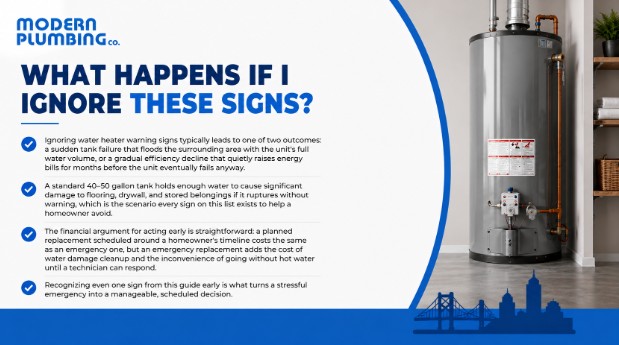
Ignoring water heater warning signs typically leads to one of two outcomes: a sudden tank failure that floods the surrounding area with the unit’s full water volume, or a gradual efficiency decline that quietly raises energy bills for months before the unit eventually fails anyway.
A standard 40–50 gallon tank holds enough water to cause significant damage to flooring, drywall, and stored belongings if it ruptures without warning, which is the scenario every sign on this list exists to help a homeowner avoid.
The financial argument for acting early is straightforward: a planned replacement scheduled around a homeowner’s timeline costs the same as an emergency one, but an emergency replacement adds the cost of water damage cleanup and the inconvenience of going without hot water until a technician can respond.
Recognizing even one sign from this guide early is what turns a stressful emergency into a manageable, scheduled decision.
How old does a water heater need to be before I should worry about replacement?
A standard tank water heater, 8 to 12 years old, carries a meaningfully higher risk of failure, even without other symptoms yet. Tankless systems last 15 to 20 years, so age becomes a concern later for that system type.
Is rust-colored water always a sign that I need a new water heater?
Rust-colored water from the hot tap, specifically, while the cold tap runs clear, indicates tank lining corrosion, which means replacement. If both taps show rust, the cause is more likely in the home’s pipes rather than the water heater.
Can a noisy water heater be repaired instead of replaced?
Yes, in most cases. Rumbling or popping noises usually signal sediment buildup, which a professional tank flush resolves if addressed promptly. Sediment left untreated for years can eventually corrode the tank from beneath.
Does every water heater leak mean I need a replacement?
No. A leak at a fitting or valve is typically a simple, inexpensive repair, while a leak from the main tank body itself means replacement, since a corroding tank cannot be restored. Identifying the exact leak location determines which applies.
When does it make more financial sense to replace a water heater than to repair it?
Repair stops making financial sense once the repair cost approaches half the price of a comparable new installation, since that money is often better spent on a new unit with a full warranty. Recurring repairs on an aging unit are a similar signal to replace.
What happens if I keep using a water heater that’s showing warning signs?
Ignoring warning signs typically leads to either a sudden tank failure that floods the surrounding area or a gradual efficiency decline that raises energy bills before eventual failure. Acting on an early sign avoids both outcomes.
Is inconsistent hot water temperature a sign of a failing water heater?
Inconsistent temperature usually traces to sediment buildup, a failing heating element, or an aging thermostat. A failing element or thermostat is typically repairable if the tank itself remains in good condition.
Should I worry about bacterial growth if my water heater runs cooler than usual?
The U.S. Department of Energy notes a very slight risk of promoting bacterial growth at the standard 120°F setting, though this level is considered safe for most households. A consistently cool-running unit is more often a sign of mechanical failure worth having inspected, regardless.
How many warning signs usually appear before a water heater fails completely?
Most water heaters show at least one sign — age, noise, or inconsistent temperature — well before a sudden failure, though a tank-body leak or rust-colored water can appear shortly before failure with little additional warning. Multiple signs appearing together typically mean replacement is closer than repair can address.
Can I tell if my water heater needs replacement without calling a plumber?
A homeowner can identify several signs independently — age, rust-colored water, unusual noise, visible leaks — but confirming the underlying cause and the repair-versus-replace decision requires a professional inspection. A technician can also check components like the anode rod that aren’t visible without opening the unit.
Schedule a water heater inspection with Modern Plumbing — straight answers on repair vs. replace, no upsell.
Quick Links
Plumbing Services
SW Washington Service Areas
Oregon Service Areas