

Originally published: April 2026 | Updated: June 2026

Trenchless sewer repair fixes or replaces a damaged underground sewer lateral through two small access points — no open trench, no destroyed parking apron, no multi-day business shutdown.
Portland commercial operators who choose open-cut excavation on a 100-foot lateral under a concrete parking surface pay $200–$500 per linear foot for the repair, then $10–$30 per square foot to restore the concrete afterward.
A restaurant generating $8,000 per day loses $16,000 over two shutdown days — compared with a trenchless premium that rarely exceeds $6,000 for a standard commercial lateral. The math favors trenchless on most Portland commercial sites before a single scope detail is compared.
Trenchless sewer repair is a pipe rehabilitation or replacement method that accesses a damaged underground lateral through existing cleanouts or two small excavated pits rather than a continuous open trench.
Portland commercial operators choose trenchless methods for three reasons that open-cut excavation cannot address. First, trenchless repair preserves hardscaping — concrete parking aprons, loading dock slabs, and interior floors — that costs $10–$30 per square foot to restore after conventional excavation.
Second, CIPP lining returns sewer service within 6–10 hours, keeping a commercial operation running the same day rather than waiting three to five days for excavation and backfill.
Third, trenchless work requires minimal coordination with adjacent tenants and city right-of-way offices — a significant timeline advantage on Portland’s dense commercial corridors.
Portland’s commercial building stock concentrates trenchless demand in specific districts. Buildings throughout the Central Eastside Industrial District, Old Town Chinatown, and NW Portland sit on clay and cast-iron sewer laterals installed between the 1920s and 1960s.
Clay laterals crack at joints under Portland’s seasonal soil movement. Cast iron laterals corrode from the inside outward, narrowing the pipe interior and producing recurring slow-drain calls that drain cleaning temporarily resolves but does not permanently fix. Both material types are strong trenchless candidates before a lateral failure forces an emergency response at after-hours rates.
Modern Plumbing PDX performs trenchless pipe repair for commercial clients across Portland, Tualatin, Beaverton, Lake Oswego, Hillsboro, Tigard, and SW Washington — completing camera inspection, damage diagnosis, and fully permitted repair under a single licensed contractor relationship.
Trenchless sewer repair uses two distinct methods — CIPP lining and pipe bursting. Pipe condition, not cost, determines which method is correct for a given Portland commercial lateral.
CIPP Lining is a trenchless pipe rehabilitation method that creates a new, seamless pipe inside an existing damaged pipe without removing the original.
A flexible textile liner saturated with epoxy resin is inserted through an existing cleanout, expanded against the interior of the host pipe, and cured using heat, steam, or UV light.
The cured liner bonds permanently to the host pipe, sealing every crack, joint gap, and root intrusion point in a single pass. CIPP liners carry a service life of 50 or more years when installed with a high-quality epoxy system.
Pipe bursting is a trenchless pipe replacement method that fractures an existing pipe outward while simultaneously pulling a new high-density polyethylene (HDPE) pipe into the void.
A hydraulic bursting head is pulled from a sending pit to a receiving pit — two small excavations, not a continuous trench.
Pipe bursting replaces the entire lateral and can upsize the pipe diameter during installation. HDPE pipe installed by pipe bursting carries a manufacturer’s service life of approximately 50 years.
| Factor | CIPP Lining | Pipe Bursting |
| Definition | A new pipe formed inside the existing pipe | Existing pipe fractured; new HDPE pipe installed |
| Pipe condition required | Structurally passable on camera | Can be severely deteriorated; the rod must pass |
| Surface excavation | Cleanout access is only available in most cases | Two small pits — sending and receiving |
| Diameter change | Maintains existing diameter | Can upsize during replacement |
| Commercial sewer downtime | 6–10 hours; same-day restoration | One full workday; restored end of day |
| Portland commercial cost | $100–$300 per linear foot | $100–$300 per linear foot |
| Service life | 50+ years | ~50 years (HDPE) |
| Best Portland application | Pre-1970 clay/cast iron under active hardscape | Collapsed, undersized, or severely deteriorated pipe |
Portland commercial properties with mixed lateral conditions — some sections cracked, others collapsed — require a hybrid approach.
Modern Plumbing PDX’s commercial plumbing team assesses each run independently by recorded camera inspection before committing to any method.
Unsure which method your Portland commercial lateral needs? Call Modern Plumbing PDX at (503) 691-6166 or contact us at modernplumbingpdx.com
If you’re ready to get started, call us now!
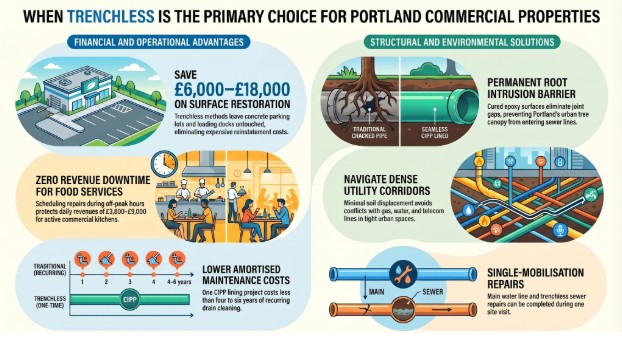
CIPP lining accesses through existing cleanouts and leaves the concrete untouched. Pipe bursting requires two pits, each roughly 2 by 3 feet. Both methods eliminate the $8,000–$24,000 surface restoration cost associated with open-cut excavation on an 80-foot Portland commercial parking apron.
A Portland restaurant or commercial kitchen that generates $5,000–$12,000 per day in revenue cannot absorb a three-day excavation shutdown.
Modern Plumbing PDX schedules CIPP lining during off-peak hours — overnight or early morning — so the commercial plumbing system is restored before the next service period opens.
Portland commercial buildings constructed before 1970 in the Central Eastside, Old Town, and NW 23rd Avenue corridors commonly contain original clay or cast-iron laterals that have been in service for 50 to 80 years.
CIPP lining seals every joint and crack in a single pass, eliminating the annual drain-cleaning service call cycle. The amortized cost of a CIPP lining project is lower than four to six years of recurring mechanical root cutting on the same lateral.
Douglas firs, oaks, and maples throughout NE Alberta, SE Hawthorne, and the Mississippi Avenue commercial corridors send roots directly into clay and into gaps at cast-iron sewer joints.
CIPP lining eliminates the joint gaps themselves — the cured epoxy surface presents no entry point for root tips. A Portland commercial sewer line that requires root cutting more than once per year is a direct candidate for CIPP lining.
Commercial properties in the Pearl District and Central Eastside share underground right-of-way with gas mains, water service lines, and telecom conduit running alongside sewer laterals.
Trenchless methods displace minimal soil and eliminate the staged excavation, utility conflict management, and shoring that open-cut work requires in mixed-utility corridors.
A licensed main water line repair, alongside a trenchless sewer repair, at the same Portland commercial site, can be completed in a single mobilization.
Trenchless sewer repair is not appropriate for four specific pipe conditions. A Portland commercial plumbing contractor who recommends trenchless without a prior camera inspection is skipping the diagnostic step that determines whether the method will hold.
A fully collapsed lateral prevents the sewer camera, CIPP liner, and bursting rod from passing through the damaged section. Open-cut excavation removes the failed section before any trenchless repair can proceed on the remaining run.
A severe joint offset — where adjacent pipe sections have shifted laterally rather than simply cracking — prevents a CIPP liner from seating uniformly against the offset pipe wall. Joint offsets require open-cut excavation to realign the shifted sections before lining proceeds.
Pipe bursting displaces soil outward as the hydraulic bursting head fractures the existing pipe. A Portland commercial lateral running within 18 inches of a shallow building foundation, gas main, or water service line is not a safe candidate for pipe bursting.
CIPP lining is the appropriate trenchless alternative when the lateral meets structural requirements. Per Portland City Code Chapter 17.32 at portland.gov, any work near city sewer infrastructure in the right-of-way requires prior BES authorization.
Orangeburg pipe is a tar-paper and asphalt composite installed in Portland commercial buildings constructed between approximately 1945 and 1972. Orangeburg softens and deforms unpredictably under ground moisture, making CIPP liner adhesion inconsistent and the reliability of rod travel unreliable.
Open-cut replacement with HDPE or PVC is the correct approach for Orangeburg laterals. A sewer line repair camera inspection identifies Orangeburg by its distinctive blackened, layered interior wall visible on the recorded feed.
If you’re ready to get started, call us now!
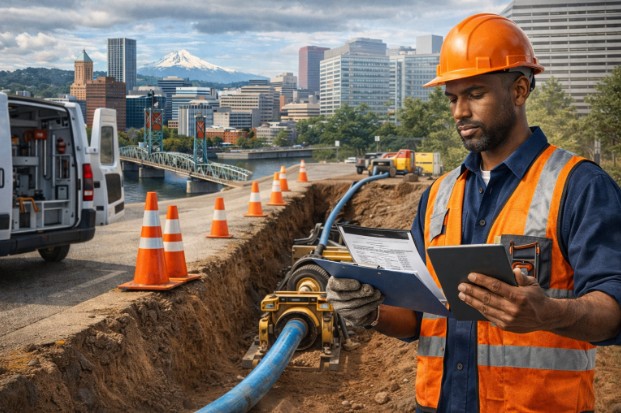
Every commercial sewer lateral repair in Portland — trenchless or open-cut — requires two separate permits before work begins.
Plumbing trade permit — issued by Portland Permitting & Development under Portland City Code Chapter 25.05. The licensed plumbing contractor purchases the permit. Work started without a permit triggers an investigation fee equal to PP&D’s actual verification cost, as well as a potential stop-work order and permit revocation.
UR/UC public works permit — required when the trenchless repair extends into the public right-of-way to connect the building lateral to the city sewer main, per BES Administrative Rule ENB-4.17 at portland.gov and Portland City Code Chapter 17.32. BES contact for lateral repair permits: 503-823-7761. The UR/UC permit guide at portland.gov details application requirements.
Portland Permitting & Development added a $295 inspection surcharge to sewer lateral repair permits effective July 1, 2025, per the PP&D fee schedule at portland.gov. The $295 surcharge applies to every commercial sewer lateral permit regardless of repair method.
The commercial plumbing inspection sequence for a trenchless lateral repair includes the sanitary sewer inspection (IVR Code 350) after installation and the final plumbing inspection (IVR Code 399) before the permit closes.
Under ORS 693.020, all commercial plumbing work must be performed by a licensed Oregon journeyman plumber under a CCB-registered contractor — verifiable through the Oregon CCB license search at oregon.gov.
Modern Plumbing PDX pulls both the PP&D plumbing trade permit and the BES UR/UC right-of-way permit where required, manages the full inspection sequence, and delivers the closed permit record to the building owner on project completion.
Permitted, inspected, and licensed trenchless sewer repair for Portland commercial properties — Modern Plumbing PDX manages every step from the $295 inspection surcharge to final permit sign-off. Call (503) 691-6166.
What is trenchless sewer repair, and how does it differ from open-cut excavation?
Trenchless sewer repair fixes or replaces a damaged sewer lateral through small access points rather than a continuous open trench. Trenchless methods preserve commercial hardscaping, reduce sewer downtime to one business day or less, and eliminate $8,000–$24,000 in surface restoration costs on Portland commercial properties with concrete parking or loading surfaces.
Which trenchless method is appropriate for a Portland commercial lateral—CIPP lining or pipe bursting?
CIPP lining is correct when the existing lateral is structurally passable on camera inspection, and the operation requires minimal surface disruption. Pipe bursting is correct when the lateral is too deteriorated for liner adhesion or requires a larger diameter. A sewer camera inspection — not a cost comparison — determines which method applies to a specific Portland commercial lateral.
How long does commercial trenchless sewer repair take in Portland?
CIPP lining on a standard Portland commercial lateral takes 6–10 hours, with sewer service restored the same day or the following morning. Pipe bursting takes one full workday, with service restored by the end of the day. Large-diameter or multi-run commercial systems may require two staged workdays to maintain partial sewer service during the repair.
Does a commercial trenchless sewer repair in Portland require a permit?
Yes. Portland Permitting & Development requires a plumbing trade permit under Portland City Code Chapter 25.05 for every commercial sewer lateral repair. Work extending into the public right-of-way also requires a BES UR/UC permit under ENB-4.17 and City Code Chapter 17.32. Portland added a $295 inspection surcharge to lateral repair permits effective July 1, 2025.
How much does commercial trenchless sewer repair cost in Portland in 2026?
Commercial CIPP lining and pipe bursting both run approximately $100–$300 per linear foot in the Portland metro area. Open-cut excavation costs $200–$500 per foot before surface restoration, which adds $10–$30 per square foot on concrete commercial surfaces. For a lateral run 80 feet under a parking apron, trenchless methods save $8,000–$24,000 in surface restoration costs compared to open-cut for the same repair.
What pipe materials in Portland commercial buildings are compatible with trenchless repair?
CIPP lining and pipe bursting are both compatible with clay, cast iron, and concrete — the three most common sewer pipe materials in Portland commercial buildings constructed before 1970. Orangeburg pipe, installed in some Portland commercial buildings between 1945 and 1972, is not reliably compatible with either trenchless method and requires open-cut replacement with HDPE or PVC.
When is trenchless sewer repair not appropriate for a Portland commercial property?
Trenchless sewer repair is not appropriate when the lateral has fully collapsed, and no instrument can pass through, when severe joint offsets prevent uniform CIPP liner seating, when pipe bursting would displace soil dangerously close to adjacent foundations or utilities, or when the pipe material is Orangeburg. A recorded camera inspection identifies all four conditions before any scope is committed.
Can pipe bursting upsize a commercial sewer lateral’s diameter?
Yes. Pipe bursting pulls a new HDPE pipe into the void left by the fractured existing pipe and can increase the pipe diameter during installation. A Portland commercial building whose original 4-inch clay lateral now serves a higher-occupancy tenant can upsize to a 6-inch HDPE lateral through pipe bursting without opening a full trench across the property.
What is the $295 inspection surcharge on Portland sewer lateral permits?
Portland Permitting & Development added a $295 inspection fee to sewer lateral repair and connection permits, effective July 1, 2025, per the PP&D fee schedule. The surcharge applies to every commercial sewer lateral permit, regardless of the repair method, and is in addition to standard permit fees calculated based on the scope of work.
How does Modern Plumbing PDX handle the permit process for commercial trenchless repairs?
Modern Plumbing PDX pulls the PP&D plumbing trade permit and the BES UR/UC right-of-way permit where the repair extends into the public right-of-way, schedules all required inspections, including the IVR Code 350 sanitary sewer and IVR Code 399 final plumbing inspections, and delivers the closed permit record to the building owner on project completion.
Quick Links
Plumbing Services
SW Washington Service Areas
Oregon Service Areas