

Originally published: January 2022 | Updated: June 2026

Portland restaurant plumbing projects require a licensed Oregon journeyman plumber, a commercial plumbing permit from Portland Permitting & Development, and — for any food service establishment — separate approvals from the Multnomah County Health Department and the Oregon Department of Agriculture Food Safety Division before PP&D issues the plumbing permit.
The 2023 Oregon Plumbing Specialty Code (OPSC), adopted under OAR 918-750, governs all restaurant plumbing installations, alterations, and repairs statewide through September 30, 2026.
Your restaurant’s plumbing permit requires Health Department and BES approvals before PP&D signs off. Modern Plumbing coordinates every agency in the process. Schedule your restaurant plumbing consultation.
A commercial plumber serving Portland restaurants handles every plumbing system that supports food preparation, sanitation, and waste disposal — from the grease trap under a three-compartment sink to the main sewer lateral connecting the building to the city system.
Restaurant plumbing differs from standard commercial work because food service operations generate fats, oils, and grease that require specialized interception equipment, and because multiple regulatory agencies oversee the plumbing systems in addition to Portland Permitting & Development.
Kitchen plumbing systems in a Portland restaurant typically include:
Restroom and front-of-house plumbing adds a second layer of scope:
OPSC Chapter 10 requires every food service establishment that connects to a public sewer system to install grease-processing or interception equipment.
Portland’s Bureau of Environmental Services (BES) enforces FOG discharge limits under its pretreatment program and conducts inspections of restaurant grease management systems throughout the city.
Undersized interceptors fail plan review and restart the ten-business-day review clock.
Grease traps and grease interceptors serve the same function — separating fats, oils, and grease from wastewater before it enters the municipal sewer — but differ in size, location, and capacity.
| Feature | Grease Trap (Point-of-Use) | Grease Interceptor (In-Ground) |
| Typical capacity | 20–100 gallons | 500–2,000+ gallons |
| Installation location | Under or near individual fixtures | Buried outside the building or in a mechanical room |
| Best suited for | Low-volume operations, cafés, small kitchens | Full-service restaurants, high-volume kitchens |
| Cleaning frequency | Weekly to biweekly | Every 30–90 days, depending on volume |
| OPSC sizing basis | Fixture drain flow rate | Total fixture unit load from all connected kitchen drains |
| Portland BES inspection | Subject to the BES FOG inspection program | Subject to the BES FOG inspection program |
BES enforces Portland’s FOG discharge limits through scheduled and unannounced inspections. Restaurants that exceed discharge limits or fail to maintain grease interception equipment face compliance orders, fines, and potential restrictions on sewer service.
BES maintains the FOG compliance program through the Portland Bureau of Environmental Services at portland.gov.
A restaurant that opens without a properly sized and inspected grease interceptor operates in violation of both the OPSC and Portland’s sewer use regulations from the first day of service.
If you’re ready to get started, call us now!
Restaurant plumbing projects in Portland require three separate agency approvals before work can proceed — more than any other commercial building type.
Portland Permitting & Development issues the commercial plumbing trade permit, but will not issue it for food service plumbing work until the Multnomah County Health Department and the Oregon Department of Agriculture Food Safety Division have separately approved the food service layout.
The three-agency approval sequence follows a fixed order:
Skipping or reversing this sequence wastes time. A plumbing permit application submitted to PP&D without Health Department and Agriculture clearance is returned without review, and the restaurant owner loses position in PP&D’s plan review queue.
Every restaurant plumbing project that modifies the system beyond routine maintenance requires a commercial plumbing permit under Portland City Code Chapter 25.05.
The most common restaurant-specific permit triggers include:
Routine maintenance — clearing a drain blockage without disconnecting fixtures, replacing a faucet washer, or swapping a toilet flapper — falls outside the permit requirement. The line between maintenance and alteration is the most common compliance mistake in restaurant properties.
Permits expire if work does not commence within 180 days or is suspended for 180 consecutive days. All Portland commercial plumbing permits carry a 12% Oregon state surcharge on the base permit fee, per the PP&D fee schedule at portland.gov.
Restaurant tenant improvement or new buildout in Portland? Modern Plumbing coordinates PP&D permits, Health Department review, and BES grease interceptor compliance — all managed by one contractor. Call (503) 691-6166.
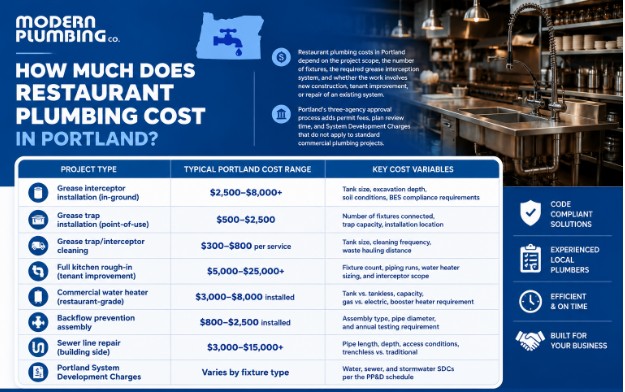
Restaurant plumbing costs in Portland depend on the project scope, the number of fixtures, the required grease interception system, and whether the work involves new construction, tenant improvement, or repair of an existing system.
Portland’s three-agency approval process adds permit fees, plan review time, and System Development Charges that do not apply to standard commercial plumbing projects.
| Project Type | Typical Portland Cost Range | Key Cost Variables |
| Grease interceptor installation (in-ground) | $2,500–$8,000+ | Tank size, excavation depth, soil conditions, BES compliance requirements |
| Grease trap installation (point-of-use) | $500–$2,500 | Number of fixtures connected, trap capacity, installation location |
| Grease trap/interceptor cleaning | $300–$800 per service | Tank size, cleaning frequency, waste hauling distance |
| Full kitchen rough-in (tenant improvement) | $5,000–$25,000+ | Fixture count, piping runs, water heater sizing, and interceptor scope |
| Commercial water heater (restaurant-grade) | $3,000–$8,000 installed | Tank vs. tankless, capacity, gas vs. electric, booster heater requirement |
| Backflow prevention assembly | $800–$2,500 installed | Assembly type, pipe diameter, and annual testing requirement |
| Sewer line repair (building side) | $3,000–$15,000+ | Pipe length, depth, access conditions, trenchless vs. traditional |
| Portland System Development Charges | Varies by fixture type | Water, sewer, and stormwater SDCs per the PP&D schedule |
These ranges represent typical 2026 Portland-area costs. Actual project costs vary based on building conditions, access, and specific code requirements. Modern Plumbing provides itemized estimates before work begins, including permit fees, SDC estimates, and grease interceptor sizing.
Restaurant owners planning tenant improvements should budget for the three-agency approval timeline in addition to construction costs.
The Multnomah County Health Department review, Oregon Department of Agriculture review, and PP&D plan review sequence typically adds three to six weeks before a plumbing permit is issued — time that directly affects lease commencement and opening schedules.
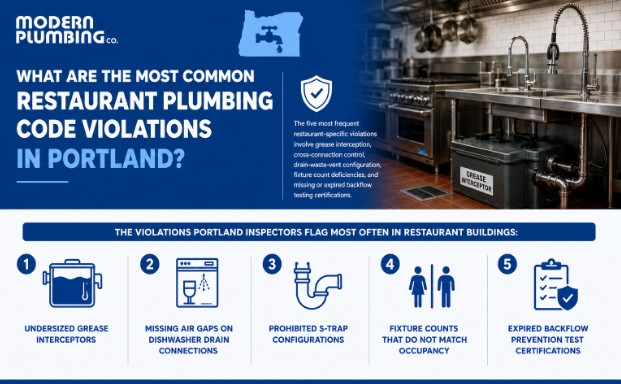
Portland restaurant plumbing inspections consistently result in violations that cost restaurant owners reinspection fees, project delays, and — in severe cases — Health Department closure orders.
The five most frequent restaurant-specific violations involve grease interception, cross-connection control, drain-waste-vent configuration, fixture count deficiencies, and missing or expired backflow testing certifications.
The violations Portland inspectors flag most often in restaurant buildings:
Scheduling a pre-inspection review with a licensed plumber before the PP&D inspector arrives catches violations before they generate reinspection fees.
A compliance checklist review applied to the restaurant’s specific permit scope reduces the risk of failed inspections, and a commercial plumbing maintenance program that includes annual backflow testing and scheduled grease trap service eliminates the two most preventable violation categories.
If you’re ready to get started, call us now!
Oregon law under ORS 693.020(2) prohibits anyone other than a licensed Oregon journeyman plumber from performing plumbing installations, alterations, or remodeling in a commercial building offered for sale, rent, or lease.
Restaurant owners, general managers, and maintenance staff cannot legally perform permitted plumbing work regardless of skill level.
A licensed commercial plumbing contractor serving Portland restaurants requires three verifiable credentials:
Restaurant plumbing adds a fourth qualification that standard commercial work does not require: experience with the three-agency approval process specific to food service establishments.
A plumber who handles office buildouts and retail tenant improvements may hold all required credentials but lack familiarity with Multnomah County Health Department timelines, BES FOG compliance requirements, and the grease interceptor sizing calculations under OPSC Chapter 10.
Before authorizing work, restaurant owners should confirm the contractor has completed food service plumbing projects in Portland within the past 24 months, can demonstrate familiarity with the Health Department and Agriculture approval sequence, pulls permits and schedules PP&D inspections directly rather than delegating to the restaurant owner, and provides a written scope of work that includes grease interceptor sizing, fixture unit calculations, and SDC estimates.
A contractor vetting checklist that covers CCB status, BCD Supervising Plumber verification, insurance, and restaurant-specific experience protects the restaurant owner’s insurance standing, lease obligations, and permit record.
Modern Plumbing holds active CCB registration (CCB #87906), BCD licensing, current liability insurance, and a Portland City Business License.
The company has served Portland-area restaurants, commercial kitchens, and food service operations since 1959. Contact Modern Plumbing at (503) 691-6166 — licensed, permitted, and restaurant-experienced for every scope from grease interceptor installation to full kitchen buildout.
Does every Portland restaurant need a grease interceptor?
OPSC Chapter 10 requires grease-processing or interception equipment for every food service establishment that connects to a public sewer system. The Portland Bureau of Environmental Services enforces FOG discharge limits and inspects restaurant grease management systems. Operating without a properly sized interceptor violates both the OPSC and Portland sewer use regulations.
How often do Portland restaurants need their grease traps cleaned?
Cleaning frequency depends on trap or interceptor size and kitchen volume. Point-of-use grease traps typically require weekly to biweekly cleaning. In-ground grease interceptors require pumping every 30 to 90 days. Portland BES may mandate specific cleaning schedules based on inspection findings and FOG discharge monitoring.
What permits does a restaurant plumbing project require in Portland?
Restaurant plumbing projects in Portland require a commercial plumbing trade permit from Portland Permitting and Development, approval of the food service layout from the Multnomah County Health Department, and clearance from the Oregon Department of Agriculture Food Safety Division. PP&D will not issue the plumbing permit until both agency approvals are on file.
Can a restaurant owner do their own plumbing work in Oregon?
No. ORS 693.020(2) prohibits anyone other than a licensed Oregon journeyman plumber from performing plumbing installations, alterations, or remodeling in a commercial building. The residential owner exemption under ORS 693.020(1)(a) does not extend to restaurants, commercial kitchens, or any building offered for sale, rent, or lease.
How much does a grease interceptor cost to install in a Portland restaurant?
In-ground grease interceptor installation in Portland typically costs between $2,500 and $8,000 or more, depending on tank size, excavation requirements, soil conditions, and BES compliance specifications. Point-of-use grease traps range from $500 to $2,500 installed. Costs vary by project scope and building conditions.
What happens if a Portland restaurant fails a BES FOG inspection?
Restaurants that exceed Portland’s FOG discharge limits or fail to maintain grease interception equipment face BES compliance orders requiring corrective action within a specified timeline. Continued non-compliance can result in fines, mandatory equipment upgrades, increased inspection frequency, and potential restrictions on sewer service.
How long does the permit process take for restaurant plumbing in Portland?
The three-agency approval sequence — Multnomah County Health Department, Oregon Department of Agriculture, and PP&D plan review — typically adds three to six weeks before a plumbing permit is issued. PP&D commercial plan review alone takes approximately ten business days after both agency approvals are received.
What is the most common restaurant plumbing violation in Portland?
Undersized grease interceptors rank as the most frequent restaurant-specific plumbing violation in Portland. Fixture unit counts that do not match the actual kitchen equipment load produce plan review rejections, and interceptors modified during construction without an updated plan review result in inspection failures at rough-in.
Do Portland restaurants need annual backflow testing?
Portland requires annual testing of backflow prevention assemblies on all commercial properties that pose a cross-connection risk. Restaurants operating with expired backflow test certifications face BES compliance notices and potential water service restrictions. Annual testing through a certified backflow tester maintains compliance.
What plumbing inspections does Portland require for restaurant projects?
Portland PP&D requires sequential inspections: underslab/groundwork, rough-in/top-out, backflow device installation, water heater installation, water service, sanitary sewer, and final plumbing. All rough-in inspections must pass before walls can close. A final permit inspection closes the permit record.
Does adding restaurant seating require additional plumbing fixtures?
Increasing a restaurant’s seating capacity may trigger minimum fixture count requirements under the OPSC and Oregon Structural Specialty Code. The number of required restroom fixtures is calculated based on occupancy classification and maximum occupant load. Adding fixtures triggers Portland System Development Charges and requires a plumbing permit.
How does the 2026 OPSC affect Portland restaurant plumbing projects?
The 2026 OPSC takes effect October 1, 2026, based on the 2024 Uniform Plumbing Code with Oregon amendments. Restaurant projects permitted before that date proceed under the 2023 OPSC. Projects permitted after October 1 must comply with the new code. Restaurant owners planning major kitchen buildouts for late 2026 should confirm the timing of the code transition with their plumbing contractor.
Quick Links
Plumbing Services
SW Washington Service Areas
Oregon Service Areas