

Originally published: August 2026

Repiping in Portland isn’t a single decision — it’s a choice between an isolated repair, a partial repipe, and a whole-home repipe, and the right scope depends on pipe material, failure pattern, and age rather than a symptom checklist.
A single leak in an otherwise sound system typically calls for an isolated repair; failure concentrated in one material or zone typically calls for a partial repipe.
A system nearing the end of its material lifespan, with failures spreading across zones, typically calls for a whole-home repipe.
Guessing at a “whole-home repipe” before an evaluation risks paying for more than the home needs. Modern Plumbing Co.’s repiping services start with a comprehensive evaluation of the existing system.
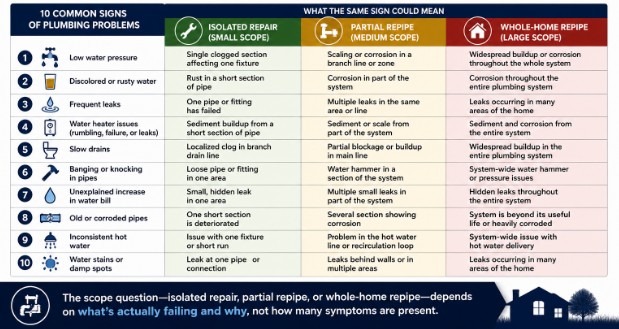
A symptom checklist — low pressure, discoloration, frequent leaks — tells a homeowner something is wrong, but it doesn’t tell them how much of the system needs to change.
The same symptom can point to three different scopes of work. Low water pressure at one fixture might be a single clogged section; low pressure throughout the house might mean the whole supply system has scaled down internally.
A homeowner who repipes the whole house based on one symptom may pay for work the system didn’t need; a homeowner who patches one leak in a system with widespread corrosion may be back for another repair within months.
The scope question—isolated repair, partial repipe, or whole-home repipe—depends on what’s actually failing and why, not how many symptoms are present.
Modern Plumbing Co., a Portland, Oregon plumbing contractor serving the metro area since 1959, treats the evaluation as the starting point of every repiping conversation rather than working backward from a symptom list.
If you’re ready to get started, call us now!
The following reflects the criteria Modern Plumbing Co.’s technicians weigh during an evaluation, not a universal industry rule. Three factors typically guide the decision between an isolated repair, a partial repipe, and a whole-home repipe:
Repiping replaces old or failing pipes with new ones. An isolated repair addresses a single failed section while leaving the rest of the system in place.
A partial repipe replaces an entire material or zone — for example, all the galvanized supply lines while leaving newer copper additions untouched — while a whole-home repipe replaces the full supply system.
An isolated repair replaces a single damaged section of pipe while leaving the rest of the supply system in place.
This scope fits when a leak, corrosion point, or damaged fitting is confined to one location and the surrounding pipe — checked during the same evaluation — shows no comparable wear. Typical isolated-repair scenarios include:
It’s generally not the right scope when the same material is present throughout the home and has reached a similar age and condition, since fixing one section often just delays the next failure elsewhere in the same material.
A partial repipe replaces an entire pipe material or a defined zone of the home’s supply system while leaving newer or unaffected sections in place.
This scope commonly applies to older Portland homes in two situations:
As a general plumbing practice, mixing materials in a partial repipe requires attention to how the new and existing pipe connect; joining dissimilar metals without proper transition fittings can accelerate corrosion at the junction, which is one reason a licensed contractor evaluates the whole system before scoping a partial repipe rather than treating it as a simple material swap.
A whole-home repipe replaces the entire supply piping system, typically with copper or PEX.
This scope is typically the right call when the existing material—most often galvanized steel in older Portland homes—has reached or passed its expected service life throughout the house, and failures appear in multiple, unrelated locations rather than one concentrated area.
Galvanized steel pipe has an expected service life of roughly 20 to 50 years, according to Modern Plumbing Co.’s own published guidance; a system installed when a home was built in the early-to-mid 20th century has, in many cases, already exceeded that range.
Beyond age and leak frequency, the EPA notes that lead particles can attach to the interior surface of galvanized pipe over time, which is a separate consideration from structural failure that some homeowners weigh alongside age when deciding on a whole-home repipe.
A whole-home repipe is a larger project than an isolated repair or partial repipe, and Modern Plumbing Co.’s repiping process follows several stages:
Repiping the whole system when only one zone actually needs it means paying for work the home doesn’t need yet.
Modern Plumbing Co.’s comprehensive evaluation determines which of the three scopes actually fits before any pipe comes out.
If you’re ready to get started, call us now!
The table below maps common evaluation findings to the scope that typically applies, per Modern Plumbing Co.’s evaluation criteria. Final scope depends on the evaluation, material condition, and layout a licensed contractor confirms for the specific home.
| Evaluation Finding | Typical Scope | Why |
| Single leak or damaged fitting; surrounding pipe tests sound | Isolated repair | Only the failed section needs replacing |
| Failures concentrated in one material (e.g., original galvanized) while newer copper/PEX sections test sound | Partial repipe | Replaces the failing material without redoing sound sections |
| Failures concentrated in one zone or floor, rest of home tests sound | Partial repipe | Addresses the affected area without full-system cost |
| Galvanized pipe at or past expected service life throughout the home, with failures in multiple unrelated locations | Whole-home repipe | System-wide material age, not one isolated defect, is driving the failures |
A second table compares pipe materials by the characteristics Modern Plumbing Co. uses to guide the material conversation once scope is determined:
| Material | Expected Service Life | Common in Older Portland Homes | Used for Modern Plumbing Co. Repiping |
| Galvanized steel | Roughly 20–50 years | Yes, in homes built before approximately 1960 | No — typically the material being replaced |
| Copper | Roughly 50+ years | In additions, remodels, or newer construction | Yes |
| PEX | Not specified by manufacturer figure here; flexible, resists scale and chlorine buildup | Uncommon in original construction; used in remodels | Yes |
| PVC | Can last indefinitely if not exposed to direct sunlight | Uncommon for interior supply; more common in drain lines | Not typically used for supply repiping |
Once scope is determined, material choice — copper or PEX — and project size are among the main factors affecting repiping cost.
Modern Plumbing Co. offers two primary materials for repiping:
Materials used for supply repiping must meet the Oregon Plumbing Specialty Code regardless of which the homeowner chooses.
Most residential repiping projects take a few days to a week, with the exact timeline depending on the size of the property and the complexity of the existing system; work confined to one zone or material generally involves less area than a full-system replacement, which can affect the project timeline.
Pulling the wrong scope into a repiping quote can either underdeliver on a failing system or overcharge for one that didn’t need a full replacement.
Modern Plumbing Co. provides a detailed estimate only after the evaluation confirms which of the three scopes actually applies, since cost depends on the specifics of each project rather than a flat rate.
How do I know if I need an isolated repair, a partial repipe, or a whole-home repipe? A whole-system evaluation is the deciding factor. A single failure in an otherwise sound system typically points to an isolated repair; failure concentrated in one material or zone typically points to a partial repipe; failures spread across multiple locations in aging material typically point to a whole-home repipe.
How long do galvanized steel pipes last in Portland homes? Galvanized steel pipes have an expected service life of roughly 20 to 50 years, according to Modern Plumbing Co.’s published guidance. Homes built in the early- to mid-20th century with original galvanized supply lines have, in many cases, already reached or exceeded that range.
Can I repipe just part of my home instead of the whole system? Yes, when failure is concentrated in one material or zone. A partial repipe replaces the affected material or area, such as original galvanized sections, while leaving newer copper or PEX sections that test sound in place.
Is galvanized pipe a health concern, or just a durability concern? Both are relevant. Galvanized pipe has a limited service life before leaks and pressure loss become common, and the EPA notes that lead particles can attach to the interior surface of galvanized pipe over time, which some homeowners weigh alongside age and leak frequency.
What materials does Modern Plumbing Co. use for repiping? Modern Plumbing Co. primarily uses copper and PEX. Copper is known for durability and corrosion resistance; PEX is flexible, resists scale and chlorine, and is often more cost-effective. Both meet the Oregon Plumbing Specialty Code for residential supply piping.
How long does a repipe take? Most residential repiping projects take a few days to a week, depending on the property size and the complexity of the existing system, per Modern Plumbing Co.’s published FAQ. Work limited to one zone or material generally covers less area than a whole-home repipe.
Will mixing old and new pipe materials cause problems? It can, if the transition isn’t handled correctly. As a general plumbing practice, joining dissimilar metals without proper transition fittings can accelerate corrosion at the connection point, which is one reason a full evaluation, not just the symptomatic area, informs a partial repipe’s scope.
Does repiping increase home value? Modern Plumbing Co.’s published guidance states that a new plumbing system can be a meaningful selling point, signaling to buyers that a home is well-maintained and free of the deferred-maintenance costs associated with old, deteriorating pipes. The specific value impact depends on the local market and the scope of work completed.
How much does repiping cost? Cost depends on scope (isolated repair, partial, or whole-home), material choice, and the property’s size and complexity. Modern Plumbing Co. provides a detailed estimate after a comprehensive evaluation, rather than a flat rate, since scope is one of several cost variables.
Do I need to leave my home during a repipe? Per Modern Plumbing Co.’s published FAQ, in most cases homeowners don’t need to leave the home during repiping, though specific fixtures or zones may be temporarily out of service during work on that section.
An evaluation costs far less than repiping. Schedule a plumbing evaluation with Modern Plumbing Co. to learn what your home actually needs.
Quick Links
Plumbing Services
SW Washington Service Areas
Oregon Service Areas