

Originally published: August 2026
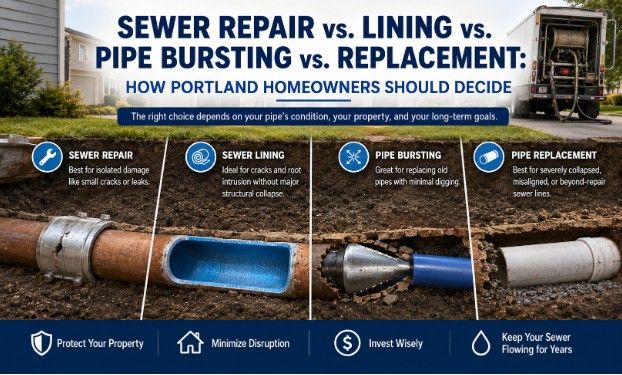
Portland homeowners choose between four sewer repair methods — spot repair, CIPP lining, pipe bursting, and full replacement — based on what a camera inspection shows inside the pipe.
A single, isolated defect in an otherwise sound pipe typically favors spot repair or lining; a collapsed, undersized, or Orangeburg pipe typically calls for bursting or open-trench replacement.
Pipe material, age, and defect count guide which category a lateral falls into.
Guessing the repair method before the camera runs risks paying for the wrong scope twice. Modern Plumbing Co. bases every sewer line repair or replacement recommendation on what the inspection actually shows.
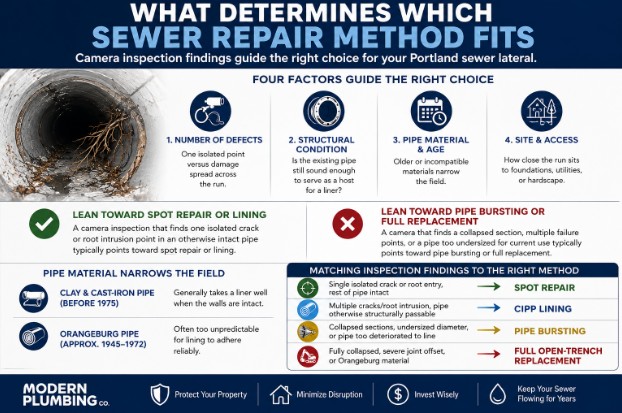
Four factors guide which of the four sewer repair methods typically applies to a Portland lateral:
A camera inspection that finds one isolated crack or root intrusion point in an otherwise intact pipe typically points toward spot repair or lining.
A camera that finds a collapsed section, multiple failure points, or a pipe too undersized for current use typically points toward pipe bursting or full replacement.
Pipe material narrows the field further, per Modern Plumbing Co.’s field guidance:
Modern Plumbing Co., a Portland, Oregon plumbing contractor serving the metro area since 1959, runs a comprehensive inspection before quoting any method, since the same symptom at the fixture — a slow drain, a backup, a wet spot in the yard — can point to any of the four repair categories depending on where and how the defect actually sits inside the pipe.
If you’re ready to get started, call us now!
Spot repair removes and replaces a short section of damaged pipe, typically under 10 feet, while leaving the rest of the line untouched.
Spot repair fits best when the camera shows one clearly localized break — a root that entered through a single joint, a section nicked during a fence or patio installation, or one compromised joint in a pipe that’s otherwise healthy end to end. It’s typically not the right call when:
Because spot repair addresses only the identified section, a homeowner choosing it should confirm the rest of the line was clear on camera—not just the segment causing symptoms.
Cured-in-place pipe (CIPP) lining is a trenchless method that creates a new pipe inside the existing damaged pipe using a resin-saturated liner cured against the host pipe’s interior wall.
Lining depends on the existing pipe still being structurally passable — the liner needs a mostly intact host to bond against.
It’s typically a strong fit for pre-1975 clay or cast-iron pipe with cracks, joint gaps, or root intrusion spread across a longer run than a single spot repair would cover, since the cured liner seals every joint in one pass rather than one point at a time. Lining generally isn’t appropriate when:
The liner has nothing sound to adhere to in any of those conditions. Trenchless sewer repair access typically runs through an existing cleanout, which is why lining usually leaves landscaping, driveways, and hardscape untouched compared with excavation-based methods.
Pipe bursting fractures the existing pipe outward while simultaneously pulling a new pipe into the space it occupied, replacing the line rather than repairing it from the inside.
Bursting is typically the call when the camera shows damage too extensive for lining:
— but the property still benefits from avoiding a continuous open trench. Unlike lining, bursting can upsize the pipe diameter during installation, which matters for a property whose original 4-inch lateral no longer matches current fixture count. Bursting requires two small access pits rather than a single cleanout entry.
As a general clearance guideline, Modern Plumbing Co. treats a run within roughly 18 inches of a shallow foundation, gas main, or water service line as a poor bursting candidate, since the fracturing process displaces soil outward.
If you’re ready to get started, call us now!
Full open-trench replacement excavates the damaged run and installs new pipe along its length, and it’s typically the only approach for a specific set of pipe conditions that neither lining nor bursting can reliably address:
The City’s own materials guidance places concrete and tile laterals before roughly 1960 and no-hub cast iron or plastic after 1975, per the Broken Sewer and Drain Lines guide, which is a useful starting point for estimating pipe age before the camera confirms it.
Starting a trenchless job that turns into open-trench mid-project delays the repair. Modern Plumbing Co. confirms method and permit scope before work begins, not after digging starts.
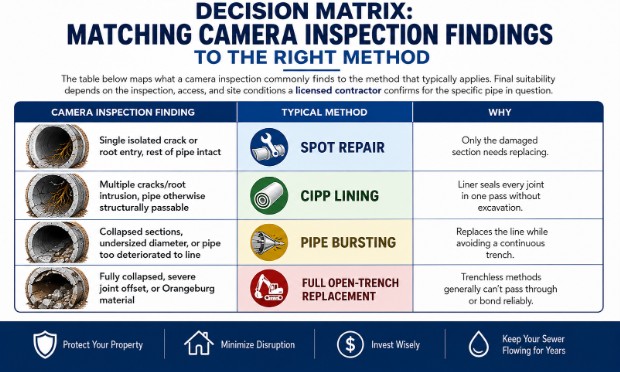
The table below maps what a camera inspection commonly finds to the method that typically applies. Final suitability depends on the inspection, access, and site conditions a licensed contractor confirms for the specific pipe in question.
| Camera Inspection Finding | Typical Method | Why |
| Single isolated crack or root entry, rest of pipe intact | Spot repair | Only the damaged section needs replacing |
| Multiple cracks/root intrusion, pipe otherwise structurally passable | CIPP lining | Liner seals every joint in one pass without excavation |
| Collapsed sections, undersized diameter, or pipe too deteriorated to line | Pipe bursting | Replaces the line while avoiding a continuous trench |
| Fully collapsed, severe joint offset, or Orangeburg material | Full open-trench replacement | Trenchless methods generally can’t pass through or bond reliably |
A second table separates the methods by what they typically require on-site rather than by the defect that triggers them:
| Method | Excavation Footprint | Diameter Change Possible | Depends on Host Pipe Condition |
| Spot repair | Small localized dig at one point | No | Yes, elsewhere in the line |
| CIPP lining | Cleanout access only, in most cases | No | Yes, throughout the lined section |
| Pipe bursting | Two small access pits | Yes, can upsize | No, replaces the pipe entirely |
| Full replacement | Continuous trench | Yes | No |
Method selection can significantly influence the cost of a Portland sewer repair project, along with pipe length, depth, and access.
Modern Plumbing Co.’s own sewer line repair and replacement pricing shows:
Trenchless methods often cost more per foot than open-trench work but avoid the landscape, driveway, and hardscape restoration costs that come with a continuous trench, which can narrow or reverse the total-cost gap on a given Portland property.
Material selection also affects cost: PVC and HDPE replacement pipe, permitted under the Oregon Plumbing Specialty Code, typically costs less to source than specialty repair materials for older clay or cast-iron systems.
Permitting is tied to where the work happens, not which method is chosen: a plumbing permit applies to private-property work, and a right-of-way permit applies when the repair extends into the right-of-way, regardless of whether the method is trenchless or open-trench, per Portland City Code Chapter 17.32 and the City’s UR and UC Permits guide.
How do I know if my sewer needs spot repair, lining, pipe bursting, or full replacement?
A camera inspection is the deciding factor. A single isolated defect in an otherwise sound pipe typically favors spot repair; damage spread across a longer intact run typically favors lining; extensive or collapsed damage typically favors bursting or open-trench replacement, depending on access and pipe condition.
Is pipe lining (CIPP) always cheaper than pipe bursting?
Not always. Lining is often less expensive per foot for pipe that’s still structurally sound, but bursting replaces the entire line and can upsize the diameter, which may reduce future repair costs. The right comparison depends on the camera findings, not price alone.
Can pipe lining fix a collapsed sewer line?
Generally not. Pipe lining depends on the existing pipe still being structurally passable so the liner has an intact host to bond against. A fully collapsed section typically blocks the liner from passing through, which rules out lining for that segment.
When is full open-trench replacement the typical approach?
Open-trench replacement is typically the approach when the lateral has fully collapsed, has a severe joint offset, or is Orangeburg pipe. In these conditions, a camera, a liner, or a bursting head generally can’t pass through or bond to the existing pipe reliably.
Does pipe bursting damage my yard less than traditional replacement?
Generally, yes. Pipe bursting requires two small access pits rather than a continuous trench along the pipe’s full length, which limits disruption to landscaping, driveways, and hardscape compared with open-trench excavation covering the same run.
Can pipe bursting be used near my house foundation?
Not always. Pipe bursting displaces soil outward as it fractures the old pipe. Modern Plumbing Co.’s general clearance guideline treats a run within roughly 18 inches of a shallow foundation, gas main, or water service line as a poor bursting candidate, often requiring open-trench work instead.
Do I need a permit no matter which sewer repair method I choose?
Permitting is tied to where the work occurs, not the method. A plumbing permit applies to work on private property, and a right-of-way permit applies if the repair extends into the public right-of-way, per Portland City Code Chapter 17.32—trenchless methods aren’t exempt.
How much does sewer line repair cost in Portland?
Small-scale sewer repairs typically start around $650, and replacing roughly 30 feet of line can run up to $7,500, averaging near $4,000, based on Modern Plumbing’s published Portland pricing. Method, pipe length, depth, and access factor into the final cost.
What pipe materials in Portland homes are hardest to line or burst?
Orangeburg pipe, a tar-paper composite Modern Plumbing Co. identifies as installed in some Portland-area homes built between approximately 1945 and 1972, is generally the most difficult material for trenchless methods, since it softens unpredictably under ground moisture.
Can I choose pipe bursting just to get a bigger sewer line, even if my current pipe is fine?
Pipe bursting is typically reserved for pipe confirmed damaged or undersized on camera, not chosen as a default upgrade. A structurally sound, correctly sized lateral generally doesn’t need bursting or replacement just to increase diameter.
Choosing a method before the camera runs is a guess, not a plan. Schedule a camera inspection with Modern Plumbing Co. to find out which repair category actually fits your line.
Quick Links
Plumbing Services
SW Washington Service Areas
Oregon Service Areas