

A failing water heater in a Portland home or business usually shows itself in the same ways: inconsistent temperature, rust-coloured water, or a tank older than 10–12 years.
Modern Plumbing has replaced and repaired water heaters across the Portland metro area, Eugene, the Oregon Coast, and Southwest Washington since 1959, working under the same family ownership for four generations.
A water heater past its expected service life fails without warning more often than it fails gradually, so the signs below matter more than they might seem.
The sections that follow cover replacement costs in the Portland market, the Oregon code requirements that apply to every installation, and how to choose between tank, tankless, and heat pump systems.
Schedule a free estimate with Modern Plumbing’s licensed Tualatin-based technicians — four generations of the same family, serving Portland since 1959.
Water heater replacement is the full removal of an existing storage tank or tankless unit and the installation of a new system, distinct from a repair that fixes a single component, such as a thermostat or heating element.
Replacement becomes the more economical choice once a tank is 8–12 years old, develops a leak, or requires a repair that costs more than half the price of a new unit.
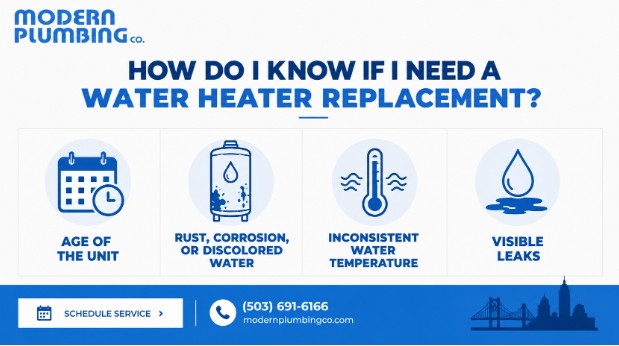
A water heater nearing failure signals it through age, visible corrosion, inconsistent heating, or an active leak — and any one of these four signs justifies a professional inspection before the unit fails completely, so a Modern Plumbing technician can confirm the cause before it becomes an emergency.
Most standard tank water heaters last 8 to 12 years, while tankless systems can run 15 to 20 years with regular maintenance. A unit at or beyond this range is more likely to fail without warning, so scheduling an inspection visit before that point allows a homeowner to plan the replacement rather than face an emergency.
Rust visible on the tank exterior, or hot water with a rust tint, signals that the tank’s interior lining has broken down. Once corrosion reaches this stage, a leak typically follows within months, not years, so replacing the unit at the first sign of rust avoids the flooring and subfloor damage a tank rupture causes.
Fluctuating hot water temperature usually traces to sediment buildup at the bottom of the tank, a failing heating element, or a thermostat reaching the end of its service life.
In hard-water areas of the Portland metro, sediment buildup accelerates this failure pattern, so an annual flush extends the tank’s working life closer to the full 12-year range.
Any water pooling at the base of a water heater points to a cracked tank or a failed fitting. A cracked tank cannot be repaired — only replaced — so identifying the source early prevents the leak from spreading to the surrounding framing.
Acting on a leak immediately limits damage to surrounding flooring and framing, preventing a $1,200–$2,500 replacement from becoming a larger water-damage repair bill.
| Sign | Likely Cause | Repair or Replace? |
| Unit 8–12+ years old | End of expected service life | Replace |
| Rust-colored hot water | Tank lining corrosion | Replace |
| Inconsistent temperature | Sediment buildup or failing element | Repair first, replace if recurring |
| Tank leak | Cracked tank or fitting failure | Replace |
| Pilot light won’t stay lit | Thermocouple or gas valve issue | Repair |
A standard 40–50 gallon tank water heater replacement in the Portland metro area costs $1,200 to $2,500 installed, while tankless systems typically run $2,500 to $4,500 due to higher equipment and venting costs.
Multiple Portland-area contractor cost estimates from Angi converge on this range for standard installations, with final pricing shaped by fuel type, tank size, and site accessibility.
| Water Heater Type | Typical Installed Cost (Portland Metro) |
| 40–50 gallon gas tank | $1,300–$2,300 |
| 40–50 gallon electric tank | $1,200–$2,100 |
| 60–80 gallon tank | $1,800–$3,100 |
| Tankless gas system | $2,500–$4,500 |
| Heat pump water heater | $2,800–$4,800 before rebates |
Several variables move the price within these ranges: fuel type changes (switching from electric to gas, or vice versa) typically add cost for new gas line or electrical circuit work; tank size beyond 50 gallons increases both equipment and labor; and a unit installed in a hard-to-access crawlspace or upper floor adds labor time.
Permit fees through the relevant city or county building department apply in most Portland-area jurisdictions, and the building department bills those fees separately from installation labor.
Energy Trust of Oregon offers a $700 incentive on qualifying heat pump water heaters and a separate incentive on ENERGY STAR-certified gas tankless systems through its Home Retrofit program, available to households served by Portland General Electric, Pacific Power, NW Natural, Cascade Natural Gas, or Avista, so choosing a qualifying unit lowers the net cost of an upgrade.
The federal Section 25C tax credit, which previously covered qualifying heat pump water heaters, expired on December 31, 2025, so Oregon’s state- and utility-funded incentives are now the primary savings path for 2026 installations.
Eligibility depends on the specific unit’s efficiency rating and the household’s utility provider, and incentive amounts are subject to change based on program funding.
A technician confirming eligibility before purchase prevents the installation of an ineligible unit.
Oregon requires every water heater to be seismically strapped under the Oregon Plumbing Specialty Code (OAR 918-750), which adopts the Uniform Plumbing Code with state-specific amendments, and most Portland-area jurisdictions require a permit before replacement work begins.
The Portland metro area sits in Seismic Zone 3, and the state code has required anchoring or strapping since a 1994 Oregon ruling addressing earthquake risk in this zone, so skipping this step leaves a tank free to topple during ground motion.
Three code requirements apply to nearly every residential replacement in the Portland area:
A licensed Oregon plumber files the permit, performs the strapping to code, and schedules the required inspection as part of a standard replacement — work that an unlicensed installation skips at the homeowner’s legal and safety risk.
A tank water heater costs less upfront and suits most single-family homes with moderate hot water demand, while a tankless system delivers continuous hot water at a higher upfront cost, and a heat pump unit cuts long-term energy costs in exchange for a larger upfront investment and specific space requirements.
| Type | Best For | Lifespan | Upfront Cost | Operating Cost |
| Tank (gas or electric) | Most homes have moderate hot water use | 8–12 years | Lowest | Moderate |
| Tankless | Homes wanting continuous hot water, limited space | 15–20 years | Highest of the three | Lower than the tank |
| Heat pump | Energy-conscious households with adequate space and airflow | 10–15 years | High before rebates | Lowest |
A heat pump water heater pulls heat from the surrounding air rather than generating it directly, which is why it requires adequate airflow space and runs at a lower operating cost than either tank or tankless alternatives — and why Energy Trust of Oregon’s $700 incentive applies specifically to this category.

A professional water heater replacement proceeds through inspection, unit selection, code-compliant installation, and post-installation testing — typically completed in a single visit for standard tank-to-tank replacements.
A Modern Plumbing technician inspects the existing unit’s age, condition, and connections to confirm that replacement is the right call rather than a lower-cost repair, and discusses household hot water demand, fuel-type preference, and budget before recommending a specific unit.
The technician shuts off the water, gas, and electrical supplies to the old unit, disconnects and removes it, then installs the new unit, completing all water, gas, and electrical connections to Oregon Plumbing Specialty Code standards, including seismic strapping.
For jurisdictions that require a permit, the plumbing contractor files it before or at the start of work and schedules the final inspection, thereby closing out the legal requirement on the homeowner’s behalf.
The technician tests the new unit for proper temperature output, checks every connection for leaks, and clears the work area, leaving the installation site as it was found.
How long does a water heater last in Portland, Oregon?
A standard tank water heater lasts 8–12 years in most Portland-area homes, while tankless systems run 15–20 years with annual maintenance. Hard water is common across the Portland metro, and it accelerates sediment buildup, which can shorten tank lifespan toward the lower end of that range without regular flushing.
Is a permit required to replace a water heater in Portland?
Most jurisdictions in the Portland metro area require a plumbing permit for water heater replacement to be filed before installation begins. A licensed plumber typically handles permit filing and the required final inspection as part of the replacement service, closing out the legal requirement for the homeowner.
Does Oregon require water heaters to be strapped for earthquakes?
Yes. The Oregon Plumbing Specialty Code (OAR 918-750) requires water heaters in Seismic Zone 3, which covers the Portland metro area, to be anchored or strapped to resist movement during an earthquake. This requirement has applied statewide since a 1994 Oregon ruling addressing seismic risk.
How much does it cost to replace a water heater in Portland?
A standard 40–50 gallon tank replacement costs $1,200–$2,500 installed in the Portland metro area, while tankless systems typically run $2,500–$4,500. Final cost depends on fuel type, tank size, site accessibility, and any seismic strapping or permit upgrades required by the installation.
Are there rebates available for a new water heater in Oregon?
Energy Trust of Oregon offers a $700 incentive on qualifying heat pump water heaters and a separate incentive on ENERGY STAR-certified tankless gas units as of 2026. Eligibility depends on the household’s utility provider and the specific unit’s efficiency rating at the time of purchase.
Should I repair or replace my water heater?
Repair makes sense for an isolated issue, such as a faulty thermostat, on a unit under 8 years old. Replacement is the more cost-effective choice once the unit exceeds 10–12 years, shows tank corrosion, or the repair cost approaches half the price of a comparable new unit.
What size water heater do I need for my home?
Tank size depends on household size and peak hot water demand; a 40-gallon tank typically serves a 1–2-person household, while a 50–80-gallon tank suits larger households with overlapping hot water use. A technician calculates peak demand during the in-home inspection visit.
Can I install a water heater myself in Oregon?
Oregon code requires licensed installation for gas and electrical connections, and an unlicensed installation that skips seismic strapping or permit filing creates both a safety risk and a code violation. Professional installation also preserves the manufacturer’s warranty coverage that self-installation often voids.
How often should a water heater be flushed?
Annual flushing removes sediment buildup that reduces heating efficiency and shortens tank lifespan, particularly in hard-water areas of the Portland metro. A technician can flush the tank during a routine annual maintenance visit.
Get a same-day water heater estimate from a Modern Plumbing technician — straight pricing, code-compliant installation, no guesswork.
Quick Links
Plumbing Services
SW Washington Service Areas
Oregon Service Areas