

Originally published: July 2026
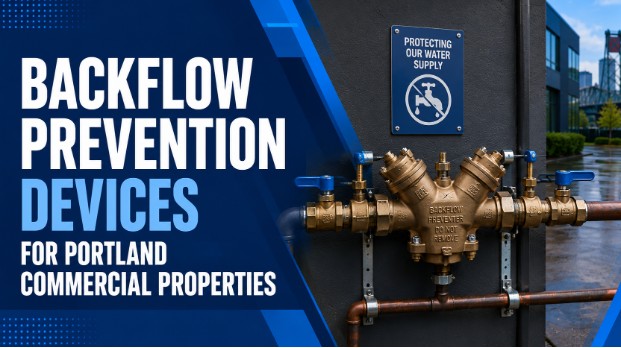
Commercial properties in Portland must install a backflow prevention assembly whenever a cross-connection exists between the potable water system and a non-potable source.
Oregon Administrative Rules 333-061-0070 and 333-061-0071 establish the minimum protection standard, and the Portland Water Bureau enforces compliance with installation, testing, and backflow device requirements locally.
The assembly required depends on the hazard level of your connection, ranging from a double-check valve assembly for low-risk services to a reduced-pressure assembly for health-hazard applications.
A missing or failing backflow assembly can trigger a water shutoff with no advance notice. Modern Plumbing installs, tests, and repairs backflow assemblies across Portland — schedule your inspection today.
Backflow is the unwanted reversal of water flow that can pull contaminants from a non-potable source into the public drinking water system. A cross-connection is any point where potable piping connects to a source that isn’t safe to drink — hot tubs, irrigation systems, and fire sprinkler systems are common examples.
Oregon Health Authority Drinking Water Services requires water suppliers to prevent contamination at every cross-connection under OAR 333-061-0070.
The Portland Water Bureau carries out this requirement locally, and property owners bear responsibility for installing, testing, and maintaining the assembly once it’s required.
If you’re ready to get started, call us now!
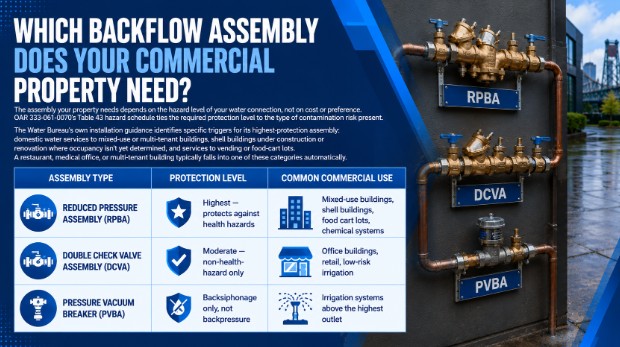
The assembly your property needs depends on the hazard level of your water connection, not on cost or preference. OAR 333-061-0070’s Table 43 hazard schedule ties the required protection level to the type of contamination risk present.
The Water Bureau’s own installation guidance identifies specific triggers for its highest-protection assembly: domestic water services to mixed-use or multi-tenant buildings, shell buildings under construction or renovation where occupancy isn’t yet determined, and services to vending or food-cart lots.
A restaurant, medical office, or multi-tenant building typically falls into one of these categories automatically.
| Assembly Type | Protection Level | Common Commercial Use |
| Reduced Pressure Assembly (RPBA) | Highest — protects against health hazards | Mixed-use buildings, shell buildings, food cart lots, chemical systems |
| Double Check Valve Assembly (DCVA) | Moderate — non-health-hazard only | Office buildings, retail, low-risk irrigation |
| Pressure Vacuum Breaker (PVBA) | Backsiphonage only, not backpressure | Irrigation systems above the highest outlet |
If you’re ready to get started, call us now!
An RPBA and a DCVA both use two check valves, but only the RPBA adds a pressure-monitored relief valve between them. That relief valve is what lets an RPBA protect against health hazards — it discharges water to the atmosphere if either check valve fails, rather than letting contaminated water reach the supply line.
A DCVA relies entirely on the redundancy of its two check valves with no relief mechanism, which is why the Water Bureau limits it to non-health-hazard connections.
Because a DCVA doesn’t discharge water, it offers greater installation flexibility — above grade, below grade, or inside a vault — whereas an RPBA requires a location with proper drainage in case it activates.
A fire sprinkler system that isn’t fully metered needs a detector assembly rather than a standard DCVA or RPBA. A double-check detector assembly (DCDA) covers fire services that pose no health risk to the water supply.
A reduced-pressure detector assembly (RPDA) is required when specific risk conditions exist.
The Water Bureau’s installation requirements name three triggers: a sprinkler system augmented with antifreeze, chemicals, or other additives; a high-rise building measuring 75 feet or more from the lowest finished floor to the top of the structure; and a fire service supplying a marina, moorage, dock, or pier.
An RPDA must sit at least 12 inches above finished grade or the 100-year floodplain, whichever is greater.
Choosing the wrong detector assembly for your fire system can delay your permit and inspection. Modern Plumbing helps Portland properties confirm the correct assembly before installation — request commercial plumbing support to get it right the first time.
OAR 333-061-0071 sets specific placement rules regardless of which assembly type your property needs. An assembly must sit adjacent to the service connection or point of delivery, and its installation must never allow continuous submersion of the unit or any submersion of an RP’s relief valve.
Height matters, too — no assembly can be installed higher than 5 feet off the ground unless a permanent, OR-OSHA-compliant platform is in place to service it safely.
Properties with safety regulations driving their layout, such as mixed-use buildings with limited mechanical room space, often need a licensed plumber to confirm placement satisfies both the state clearance rule and the Water Bureau’s local review before a permit is finalized.
Every backflow prevention assembly in Portland requires testing once a year by a state-certified backflow assembly tester. Commercial properties follow the specific testing schedule listed on their annual reminder letter from the Water Bureau, rather than a fixed calendar date.
The certified tester submits the completed report to the Water Bureau within 10 business days of the test.
A property that completes testing but misses this submission window can still face compliance issues, since the Water Bureau’s records only update once the report arrives — a distinction covered in more detail in our backflow testing guide.
Refusing to install a required backflow assembly, skipping annual testing, or ignoring a correction notice gives the Water Bureau the authority to shut off your water service without further notice.
This applies to any property with an identified cross-connection, regardless of how long the assembly has gone without service.
Restaurants and multi-tenant properties that track backflow testing alongside other recurring obligations often fold it into a single compliance checklist covering ADA, backflow, and inspection deadlines.
Properties without an established plumbing partner should confirm backflow experience, especially when using a hiring checklist to select a contractor, since not every commercial plumber tests and repairs all assembly types.
A neglected assembly can also contribute to broader plumbing emergencies — a failed assembly is one of the backflow failure scenarios Portland businesses call about most.
What is a cross-connection?
A cross-connection is any point where potable drinking water piping connects to a source that isn’t safe to drink, such as an irrigation system, fire sprinkler line, or hot tub. Oregon requires protection at every identified cross-connection under OAR 333-061-0070.
Which backflow assembly does a restaurant typically need?
Most restaurants fall under the Water Bureau’s mixed-use or multi-tenant trigger, which requires a reduced pressure assembly (RPBA) for premises isolation. The exact requirement depends on your specific water service configuration, so confirm with the Water Bureau directly.
Can I install a double-check valve assembly instead of a reduced-pressure assembly?
Only if your connection doesn’t pose a health hazard under OAR 333-061-0070’s hazard schedule. A DCVA is limited to non-health-hazard, low-to-moderate-risk connections; health-hazard connections require the higher protection level that an RPBA provides.
How high above the ground can a backflow assembly be installed?
No backflow assembly may be installed more than 5 feet above the ground unless a permanent, OR-OSHA-compliant platform is provided to allow safe servicing. This rule applies under OAR 333-061-0071 regardless of assembly type or hazard level.
Does my fire sprinkler system need a detector assembly?
Yes, if the system isn’t fully metered. A double check detector assembly covers non-health-hazard fire services, while a reduced pressure detector assembly is required for systems using chemical additives, serving high-rises, or supplying marine facilities.
How often does Portland require backflow testing?
Every assembly must be tested annually by a state-certified backflow assembly tester. Commercial properties follow the specific schedule listed on their Water Bureau reminder letter rather than a single fixed date applied to every business citywide.
What happens after my backflow assembly is tested?
Your certified tester must submit the completed report to the Water Bureau within 10 business days of the test date. Missing this submission window can create a compliance gap even if the physical test itself was completed on time.
Can the Water Bureau shut off my water for a backflow violation?
Yes. Refusing to install, test, or maintain a required assembly, or ignoring a correction notice, gives the Water Bureau authority to shut off water service without further notice, regardless of how long the property has been non-compliant.
Confirm your property has the correct backflow assembly before your next Water Bureau inspection. Modern Plumbing installs and tests RPBA, DCVA, and detector assemblies across Portland — contact us to schedule a compliance review.
Quick Links
Plumbing Services
SW Washington Service Areas
Oregon Service Areas