

Originally published: July 2026
Portland restaurants must clean their grease interceptor once FOG and solids reach 25% of the unit’s liquid depth. Restaurants must file a cleaning report with the Bureau of Environmental Services within 14 days.
Adding chemical, enzyme, or bacterial products to break down grease violates City Code 17.34 under Administrative Rule ENB-4.26.
Restaurants that skip these steps risk both direct enforcement and higher Extra Strength Charges on their sewer bill, since unmanaged FOG discharge raises a restaurant’s measured pollutant load.
Skipping a cleaning report can trigger enforcement even when your interceptor is working fine. Modern Plumbing coordinates 30-90 day cleaning and reporting for Portland kitchens — schedule your service today.
Administrative Rule ENB-4.26 bans chemical, enzyme, and bacterial additives in any grease interceptor, and the prohibition applies regardless of the product’s composition or marketing claims.
BES enforces this ban because additives break FOG into smaller particles that pass through the interceptor rather than being captured, allowing grease to reach the sanitary sewer, where it can re-solidify and cause blockages farther downstream.
Chemical additives can also damage sewer pipes over time or interfere with the biological treatment process at BES’s wastewater treatment facilities.
A restaurant relying on additives instead of scheduled pump-outs is not meeting its grease system obligation under City Code 17.34, even if the interceptor never visibly overflows.
Most Portland grease interceptors need cleaning once the combined layer of floating FOG and settled solids reaches 25% of the unit’s total liquid depth, per the city’s maintenance guidance.
Some high-efficiency HGIs are designed to hold more before performance drops, and the city allows those units to accumulate up to 75% before requiring service.
A restaurant cannot rely on a fixed weekly or monthly calendar alone to satisfy this standard — a high-volume kitchen frying food daily will hit 25% far faster than a coffee shop with minimal grease output, so the actual measurement, not an assumed schedule, determines when cleaning is due.
If you’re ready to get started, call us now!
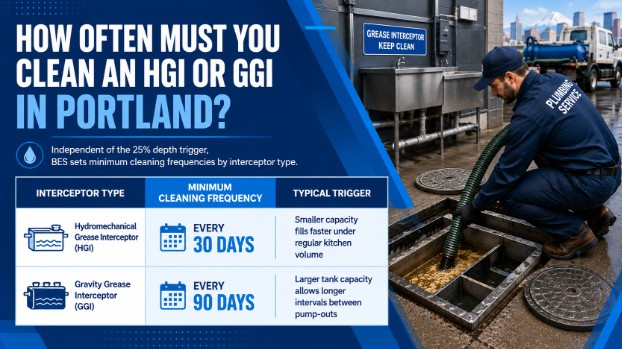
Independent of the 25% depth trigger, BES sets minimum cleaning frequencies by interceptor type.
| Interceptor Type | Minimum Cleaning Frequency | Typical Trigger |
| Hydromechanical Grease Interceptor (HGI) | Every 30 days | Smaller capacity fills faster under regular kitchen volume |
| Gravity Grease Interceptor (GGI) | Every 90 days | Larger tank capacity allows longer intervals between pump-outs |
A restaurant operating below the 25% fill mark still must service its interceptor at these minimum intervals.
High-volume kitchens frequently need service more often than the minimum, since blockages can shut down restrooms and prep sinks within minutes once an interceptor is neglected past its capacity.
BES requires a completed cleaning report within 14 days of every interceptor pump-out. Facility operators bear ultimate responsibility for this documentation even when a hired agent performs the actual cleaning — hiring a pumping company does not transfer the reporting obligation unless that company is registered as a Preferred Pumper.
Restaurants juggling multiple recurring compliance items, from backflow testing to interceptor reporting, often consolidate everything onto a single compliance checklist to avoid missing a 14-day filing window buried among other annual deadlines.
Reporting deadlines are easy to miss when they’re tracked manually across vendors. Modern Plumbing handles scheduling and documentation together — request commercial plumbing that keeps your interceptor reports on file.
If you’re ready to get started, call us now!
A Preferred Pumper is a pumping company that has agreed with the city to meet a standardized cleaning and reporting protocol. BES encourages every commercial and institutional FOG generator to use one, since a registered Preferred Pumper certifies that it will follow the required pump-out criteria and can file the completed report to BES directly on the restaurant’s behalf.
This shifts the day-to-day reporting burden off restaurant staff while still leaving the facility operator ultimately accountable if a report is late or inaccurate.
Restaurants selecting a new provider should confirm Preferred Pumper registration before signing a contract, since not every plumbing company that services grease interceptors participates in the program — a useful check is to run through the same hiring checklist used for other commercial plumbing vendors.
Beyond interceptor-specific rules, ENB-4.25 also governs the Extra Strength Charge (ESC) program, which recovers the city’s additional treatment costs from restaurants whose wastewater exceeds standard pollutant concentrations.
High-strength wastewater is defined as discharge exceeding 300 mg/L Biochemical Oxygen Demand (BOD) or 350 mg/L Total Suspended Solids (TSS). BES bills ESC through one of two methods.
| ESC Method | How It’s Calculated | Best Fit |
| Class Average ESC Method | Billed using published average discharge concentrations for the restaurant’s business type | Restaurants without individual wastewater sampling data |
| Measured ESC Method | Billed using rolling-average sampling of the restaurant’s actual discharge volume and pollutant load | Restaurants with metering or sampling access already in place |
A restaurant disputing its ESC bill has 20 business days from the date of the notice to request administrative review from BES. Restaurants that keep their OPSC-compliant interceptor properly maintained typically post lower BOD and TSS readings, which can reduce ESC exposure under either billing method compared to a restaurant with a neglected or undersized interceptor. For sizing and installation triggers, see our companion guide on grease interceptor requirements for Portland restaurants.
Can I use a grease-eating enzyme product instead of pumping my interceptor?
No. ENB-4.26 prohibits chemical, enzyme, and bacterial additives in any grease interceptor regardless of composition, because these products let FOG pass through into the city sewer system rather than being properly captured and removed during a scheduled, documented cleaning service.
How do I know when my interceptor needs cleaning?
Most interceptors require cleaning once FOG and solids reach 25% of the unit’s liquid depth. Some high-efficiency HGIs may run to 75% before service, but every interceptor also has a fixed minimum cleaning frequency that applies regardless of the actual fill level observed.
What’s the minimum cleaning frequency if my interceptor isn’t full yet?
BES requires HGIs to be cleaned at least every 30 days and GGIs at least every 90 days, even if the 25% fill threshold hasn’t been reached, since grease characteristics can change quickly without a full visual inspection of the unit.
Who files my cleaning report with the city?
The facility operator is ultimately responsible for compliance, but a registered Preferred Pumper can file the completed cleaning report to BES directly on the restaurant’s behalf. Confirm your pumping company’s Preferred Pumper status before assuming these reports are handled automatically for you.
What happens if I miss the 14-day reporting deadline?
Missing the deadline is a compliance failure independent of whether the cleaning itself occurred on schedule as required. BES can pursue enforcement action for the missing documentation alone, even when the interceptor itself was properly serviced and fully compliant with city standards.
What triggers an Extra Strength Charge on my sewer bill?
ESC applies once your restaurant’s wastewater discharge exceeds 300 mg/L BOD or 350 mg/L TSS under Portland’s ENB-4.25 rules. BES bills this charge using either a Class Average method based on your business type or a Measured method based on your actual sampled discharge.
Can I dispute my Extra Strength Charge bill?
Yes. You have 20 business days from the date of the BES notice to submit a written request for administrative review of the charge, providing any supporting information relevant to your restaurant’s actual discharge characteristics, sampling data, and volume trends.
Does using a Preferred Pumper reduce my Extra Strength Charges?
Not directly, since ESC billing is based on measured or class-average pollutant concentrations rather than pumping frequency alone. However, consistent, documented maintenance helps keep FOG concentrations lower over time, which can reduce your measured BOD and TSS readings in future billing cycles.
Confirm that your interceptor’s cleaning schedule and reporting are handled correctly before your next BES inspection. Modern Plumbing offers restaurant plumbing support across Portland — reach out to review your current maintenance plan.
Quick Links
Plumbing Services
SW Washington Service Areas
Oregon Service Areas