

Originally published: September 2026

A sewage ejector pump lifts sanitary waste from fixtures below the sewer line up to the gravity drain; a sump pump removes clear groundwater from a basin.
Both handle water that cannot leave a building by gravity, and they discharge to entirely different systems.
Multi-level commercial buildings in Portland run one, the other, or both, and the equipment sits where nobody looks until drainage stops.
Modern Plumbing Co. installs and services these systems as part of its commercial plumbing work across the Portland metro area.
Below-grade drainage stops entirely when an ejector quits. Modern Plumbing Co. inspects and services commercial ejector and sump systems across Portland — schedule a system check.
People often confuse the two because both sit in a below-grade basin and move water upward. What they move, and where it goes, separates them completely.
| Sewage ejector pump | Sump pump | Grinder pump | |
| Handles | Sanitary waste with solids from toilets and urinals | Clear water: groundwater, seepage, condensate | Sanitary waste, macerated before discharge |
| Basin type | Watertight, gastight cover, vented | Open or covered pit, no sewer gas venting requirement | Watertight, gas-tight cover, vented |
| Discharges to | Gravity building drain or sanitary sewer | Storm system or approved receiving point, subject to authorization | Gravity building drain or pressurized sewer main |
| Typical location | Below-grade restrooms, basement kitchens, parking-level fixtures | Elevator pits, mechanical rooms, foundation drains, backflow vaults | Long or high discharge runs where solids must be reduced |
| Common commercial trigger | Fixtures below the sewer crown level | Groundwater intrusion, high water table | Small-diameter or long-run discharge piping |
Getting this wrong creates a compliance problem, not a performance one. Routing sanitary waste to a sump that discharges outside the sanitary system is an illicit discharge.
Groundwater routed into the sanitary sewer without authorization is a separate violation. Portland’s Water Bureau addresses the same issue from another angle in its backflow assembly installation requirements, which call for a sump pump where an assembly vault cannot otherwise be kept free of standing water, while barring vault drains from connecting to sewers of any kind.
If you’re ready to get started, call us now!
A commercial building needs a sewage ejector whenever plumbing fixtures sit below the crown level of the main sewer, because gravity cannot carry waste uphill.
Parking-level restrooms, basement break rooms, below-grade commercial kitchens, and lower-level janitor closets all commonly fall below that line in Portland’s multi-level building stock.
This framework comes from Section 710 of the Uniform Plumbing Code, which Oregon adopts through the Oregon Plumbing Specialty Code (OPSC).
The Oregon Building Codes Division confirms the current 2023 OPSC is based on the 2021 Uniform Plumbing Code, and Portland’s own Bureau of Development Services cites OPSC 710.3 directly as the governing section for commercial ejector and simplex pump sizing.
That last point is where retrofit projects go sideways. Establishing the sewer crown and next upstream manhole cover elevations before design work sets whether a project needs an ejector, a backwater valve, or both.

Commercial ejector requirements differ substantially from single-dwelling requirements, and the distinction matters because residential specifications applied to a commercial basin produce an undersized system.
Modern Plumbing Co. pulls the trade permit and manages the inspection sequence on commercial plumbing permits for below-grade pump work.
If you’re ready to get started, call us now!
A commercial sump pump in Portland cannot discharge wherever the shortest pipe run goes. Groundwater discharge to a City system requires prior authorization, and the requirement catches building owners who assume a sump is purely a mechanical decision.
Sequencing matters as much as compliance. Obtain authorization before installation, not after a pump is already discharging, and put BES on the project schedule alongside the plumbing permit.
Discharge authorization and permit sequencing shape the install schedule. Modern Plumbing Co. handles both on Portland commercial pump projects — discuss a below-grade drainage plan.
Below-grade pump systems fail in a few recognizable ways, and most show a warning sign before drainage stops entirely. The table below reflects the failure patterns Modern Plumbing Co. sees most often in commercial service calls, not a code-defined list.
| Failure mode | Cause | Warning sign | First action |
| Impeller binding | Wipes, rags, and non-flushable material entering the basin | Pump runs without lowering the level; motor cycles and trips | Basin inspection and pump pull |
| Float switch fouling | Grease and solids coating the float or its tether | Pump fails to start, or runs continuously | Switch cleaning or replacement |
| Check valve failure | Worn flapper allowing discharge to fall back into the basin | Rapid short cycling; basin never stays down | Check valve replacement |
| Undersized pump | Capacity specified below actual fixture load | Constant cycling; premature motor failure | Load calculation against connected fixtures |
| Basin solids accumulation | Sediment and grease building below the intake | Reduced capacity, odor, alarm activations | Basin pump-out and cleaning |
| Alarm not monitored | High-water alarm installed but unwired or ignored | Discovery only at overflow | Alarm testing and monitoring assignment |
In Modern Plumbing Co.’s experience, the last row tends to produce the most costly outcomes of the six, because an unmonitored alarm turns a routine service call into a discovered flood rather than a scheduled repair.
Buildings with below-grade tenant space carry those consequences on the tenant’s floor rather than in the mechanical room.
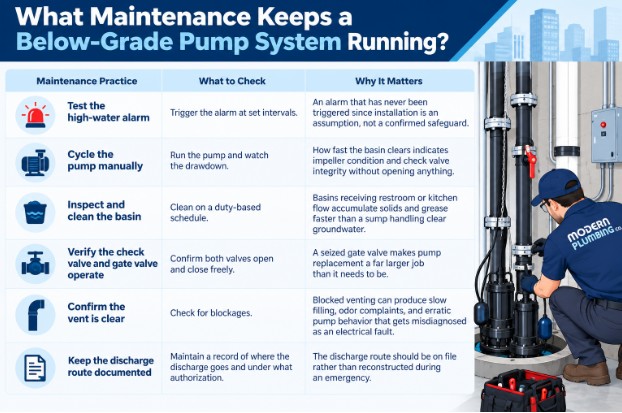
Maintenance on ejector and sump systems is straightforward and rarely scheduled, so these systems tend to be discovered rather than managed. The practices below reflect Modern Plumbing Co.’s service approach, not a code requirement.
Buildings that fold this into a structured schedule catch the conditions above while they are still service calls.
Modern Plumbing Co. builds below-grade pump service into commercial plumbing maintenance programs, and pairs basin work with commercial hydro jetting where the downstream line contributes to the problem.
Buildings without a documented response path benefit from an emergency plumbing response plan that names who gets called when the alarm sounds after hours.
Where a failing ejector turns out to be downstream of a compromised lateral, sewer line repair and replacement enters the scope, and sewer lateral responsibility determines who carries the cost of the segment involved.
Final equipment sizing and configuration depend on connected fixture load, discharge head, piping layout, and the applicable plan review — the guidance above frames the questions to resolve, not a substitute for a project-specific design.
What is the difference between a sewage ejector pump and a sump pump?
A sewage ejector pump moves sanitary waste, including solids from toilets, from below-grade fixtures up to the gravity sewer. A sump pump moves clear water — groundwater and seepage — out of a basin. Mixing them creates code violations.
When does a commercial building require a sewage ejector pump?
Whenever fixtures sit below the crown level of the main sewer, gravity drainage is not possible. The Uniform Plumbing Code framework Oregon adopts requires that drainage discharge into an approved watertight sump or receiving tank, then be lifted into the gravity building drain.
Does a Portland commercial building need a backwater valve?
Fixtures installed on a floor level lower than the next upstream manhole cover must be protected from sewage backflow by an approved backwater valve under Oregon’s adopted plumbing code. Fixtures above that elevation must not discharge through the valve — a plan reviewer confirms the exact elevation reference for a given site.
What size discharge piping does a commercial sewage ejector require?
Oregon’s OPSC applies higher capacity, ball-passage, and pipe-diameter thresholds to ejectors serving other than single dwelling units than to residential units, plus required backwater and gate valves on the discharge line. Because exact figures can vary with local amendments, the plumbing contractor confirms current thresholds against the plan reviewer before finalizing pipe sizing.
Can a commercial sump pump discharge into the sanitary sewer in Portland?
Not without authorization. Portland City Code 17.38.035 allows pumping and discharge of groundwater to a City receiving system only after a Bureau of Environmental Services discharge authorization is obtained, with quality and quantity governed by Chapters 17.34 and 17.39.
Does a sewage ejector sump need to be vented?
Yes. Oregon’s adopted plumbing code requires sumps and receiving tanks to carry substantial gastight covers with a bolt-and-gasket manhole for access, plus a vent pipe sized to the connected fixture load. Sealing without adequate venting risks slow filling and irregular pump operation.
Why do commercial sewage ejector pumps fail?
In Modern Plumbing Co.’s service experience, wipes and rags binding the impeller, grease-fouled float switches, check valve failure allowing backflow into the basin, and undersized pumps cycling constantly are the most common causes of commercial ejector failures. Basin inspection identifies which applies.
Should a commercial ejector system have a duplex pump arrangement?
Duplex arrangements pair two pumps that alternate, so a single failure does not stop drainage. Whether that’s warranted depends on what the ejector serves: a system tied to occupied restrooms or a commercial kitchen carries more exposure from a single-pump outage than one serving a rarely used floor drain. Design load and downtime tolerance both factor into the decision.
How often should a commercial ejector or sump system be inspected?
Inspection frequency depends on what the basin receives and how often the pump cycles. Systems serving restrooms or kitchens accumulate solids and grease faster than a sump handling clear groundwater, so service intervals should follow actual duty rather than a calendar default.
What happens when a sewage ejector fails in an occupied building?
Drainage from every fixture below the sewer crown stops, and the basin fills. Backup surfaces at the lowest fixtures first — floor drains, basement restrooms, and janitor sinks. A monitored high-water alarm gives advance warning; an installed-but-unmonitored alarm typically does not, since nothing prompts a response until someone discovers the overflow.
Modern Plumbing Co. has served Portland commercial properties since 1959 and answers with a live person — start a pump system conversation.
Quick Links
Plumbing Services
SW Washington Service Areas
Oregon Service Areas