

Originally published: August 2026

In Portland, sewer lateral responsibility depends on location. The property owner maintains the pipe from the house to the curb; the City maintains it from the sewer main to the curb face on paved streets with curbs.
Portland City Code Chapter 17.32.070 sets this split, and street paving, curb presence, and the main’s location can shift the exact line.
A misdiagnosed lateral repair means paying for work you don’t need. Modern Plumbing Co. traces the sewer line repair scope before digging starts.
Portland City Code Chapter 17.32.070 sets the baseline rule for sewer lateral maintenance, and it splits responsibility by pipe location rather than by who originally dug the trench.
A sewer lateral is the underground pipe that carries wastewater from a single property to the public sewer main.
Portland City Code separates lateral systems into two categories: private systems, built without a public works permit, which the served property owner maintains regardless of whether the pipe sits inside the public right-of-way; and public systems, built or accepted by the City, which the City maintains only for the specific segments named in Portland City Code Chapter 17.32.070.
Modern Plumbing Co., a Portland, Oregon plumbing contractor serving the metro area since 1959, routinely fields calls from homeowners who assume the City owns the entire lateral once it leaves the house.
Chapter 17.32.070 says otherwise: the City’s maintenance duty is limited, and everything the code doesn’t explicitly assign to the City falls to the property owner receiving service through the lateral.
That distinction matters most after a camera inspection, when a homeowner decides whether to authorize repair work or wait for a City response to a reported defect.
If you’re ready to get started, call us now!
For a City-paved street with curbs, the City maintains the lateral from the sewer main to the street-side curb face nearest the served property, per Portland City Code Chapter 17.32.070; everything from that curb face to the house is the property owner’s responsibility.
The table below breaks down responsibility by segment, using the categories in Portland City Code Chapter 17.32.070 and the City’s Broken Sewer and Drain Lines guide.
| Lateral Segment | Responsible Party | Permit Typically Required |
| House to property line | Property owner | Plumbing permit (PT) |
| Property line to curb (paved street, right-of-way) | Property owner | Plumbing permit (PT) + right-of-way permit (UR) |
| Sewer main to curb face (paved street with curbs) | City of Portland | None (City-managed) |
| Sewer main to edge of paved area (paved street, no curbs) | City of Portland | None (City-managed) |
| Nonconforming line running parallel to curb | Property owner | Right-of-way permit (UR) |
| Shared or party sewer line | Property owners served, jointly | Coordination with BES Nonconforming Sewer Hotline |
On unpaved streets, City maintenance is limited to a 28-foot-wide area centered on the right-of-way; if no portion of the lateral falls within that area, the City maintains only the wye or tee connection, per Portland City Code Chapter 17.32.070.
Per the City’s guide, newer homes typically connect at the property line because Environmental Services now brings the lateral to that point; older Portland homes often still connect at the curb, which is one reason the exact break point should be confirmed on-site rather than assumed from a neighbor’s experience.
Modern Plumbing Co.’s residential plumbing technicians confirm the break point on-site with a camera inspection before recommending the appropriate permit.
A sewer camera inspection locates the exact position of a defect inside the lateral, which determines whether the property owner or the City is responsible for the repair.
The camera enters through an existing cleanout and records the full run of the pipe, flagging blockages, cracks, offset joints, root intrusion, and material type along the way.
Because Portland’s responsibility split runs by physical location, not by symptom, a backup at the house doesn’t confirm where the actual break sits until the camera reaches it.
Modern Plumbing Co. performs a full, comprehensive inspection before recommending any repair scope, so the homeowner sees the defect’s location on video before authorizing work tied to a specific segment of the lateral.
If the City’s own dye test or notice identifies a break, a homeowner can request a second camera inspection from a licensed contractor when the finding seems inconsistent with the property’s plumbing history.
Sewer lateral repair in Portland requires a plumbing permit for private-property work, a right-of-way permit for right-of-way work, or both when the repair spans the property line.
Portland Permitting & Development issues the Plumbing Permit (PT) for repairs between the house and the property line; Transportation issues the Right-of-Way Sewer Repair Permit (UR) for repairs between the property line and the curb, including the sidewalk and parking strip, per the Broken Sewer and Drain Lines guide.
A brand-new sewer connection instead requires a Sewer Connection Permit (UC), detailed in the City’s Guide to UR and UC Permits.
Administrative Rule ENB-4.17 and Portland City Code Chapter 17.32 set the detailed rules that Environmental Services and Transportation apply to each case.
Only the property owner or a licensed, Oregon-registered plumbing contractor can legally perform sewer lateral work, and bonding and insurance requirements apply to whichever party works in the right-of-way.
A licensed contractor checklist helps confirm a contractor meets those bonding and CCB registration requirements before signing a contract.
Pulling the wrong permit delays repair by weeks. Modern Plumbing Co. handles PT and UR permit filings and coordinates city inspections from start to finish.
If you’re ready to get started, call us now!
Once the City notifies a property owner of a sewer or drain line break, the owner has 30 days to complete repairs or request additional time before the City can step in, per the City’s Broken Sewer and Drain Lines guide.
After that window, the City may perform the repair itself and place a lien against the property covering the cost, overhead charges, and civil penalties.
A property owner who believes the City misidentified the break location can have a contractor record the line on video and submit it to Environmental Services’ Nonconforming Sewer division for review before the deadline passes.
Ignoring a flagged lateral doesn’t just risk a lien; standing sewage also creates a documented health hazard the City can act on directly. Portland residents can report an active sewer issue through the Bureau of Environmental Services at any time, independent of a prior notice.
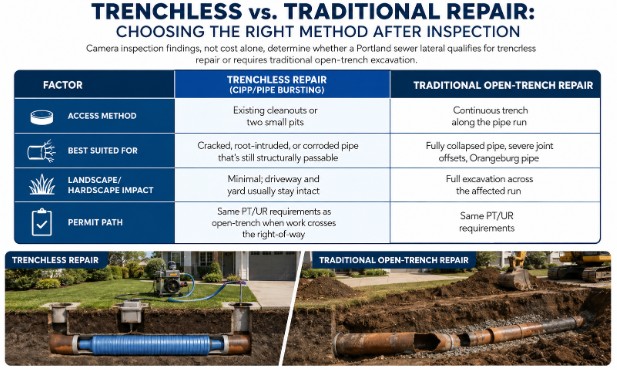
Camera inspection findings, not cost alone, determine whether a Portland sewer lateral qualifies for trenchless repair or requires traditional open-trench excavation.
| Factor | Trenchless Repair (CIPP/Pipe Bursting) | Traditional Open-Trench Repair |
| Access method | Existing cleanouts or two small pits | Continuous trench along the pipe run |
| Best suited for | Cracked, root-intruded, or corroded pipe that’s still structurally passable | Fully collapsed pipe, severe joint offsets, Orangeburg pipe |
| Landscape/hardscape impact | Minimal; driveway and yard usually stay intact | Full excavation across the affected run |
| Permit path | Same PT/UR requirements as open-trench when work crosses the right-of-way | Same PT/UR requirements |
A lateral that has fully collapsed or shifted at a joint won’t allow a camera or liner to pass, which rules out trenchless repair regardless of preference — that’s a diagnostic outcome, not a cost decision.
Orangeburg pipe, a tar-paper composite common in mid-century Portland construction, often requires open-trench replacement as well, since a licensed contractor can confirm compatibility only after seeing the pipe on camera.
Modern Plumbing Co. bases the recommendation on what the camera shows inside the pipe rather than defaulting to one method.
A shared or nonconforming sewer line shifts the standard house-to-curb split and can put an unexpected repair cost on a property owner who assumed their lateral ran independently to the main.
A common private sewer system, also called a party sewer, is a building sewer not owned by the City that serves more than one property and conveys sewage to a public sewer, lateral, or other disposal point; owners connected to a party sewer typically share repair responsibility and should contact Environmental Services’ Nonconforming Sewer Hotline before starting work.
A nonconforming sewer is a private line located off the served property or outside a recorded easement; converting one to a conforming connection can become the property owner’s cost if a public sewer extension isn’t already part of the City’s capital improvement schedule, per the City’s Nonconforming Sewers page.
Any of the signs to call a professional plumber — recurring backups, sewage odor, or a rat hole that keeps reappearing — are also worth checking against a property’s lateral configuration before assuming a straightforward house-to-curb repair.
Who is responsible for a sewer lateral in Portland — the homeowner or the city?
Responsibility splits by location under Portland City Code Chapter 17.32.070. The property owner maintains the lateral from the house to the curb, including right-of-way portions. The City of Portland maintains the segment from the sewer main to the curb face on paved streets with curbs.
What does Portland City Code 17.32.070 say about lateral maintenance?
Chapter 17.32.070 defines private systems, maintained entirely by the property owner regardless of right-of-way location, and public systems, where City maintenance is limited to specific lateral segments. Everything the code doesn’t assign to the City falls to the property owner.
What permit is needed to repair a sewer lateral in the right-of-way?
A right-of-way sewer repair permit, called a UR permit, covers work between the property line and the curb, including the sidewalk and parking strip. Transportation issues and inspects UR permits. A separate plumbing permit still applies to any portion of the repair on private property.
Does a homeowner need a permit to repair the sewer line on private property?
Yes. A plumbing permit (PT) from Portland Permitting & Development is required for sewer repair between the house and the property line, and the completed work must pass inspection before covering the pipe. Only a licensed contractor or the property owner may perform the work.
What happens if the city notifies a homeowner about a broken sewer lateral?
The property owner has 30 days to complete repairs after notice, or request more time. After that window, the City may perform the repair itself and place a lien against the property covering the cost, overhead charges, and civil penalties.
Is a sewer camera inspection required before repairing a lateral?
A permit doesn’t require a camera inspection by law, but it’s the standard first step to confirm where a defect is before authorizing repair. Without it, a homeowner risks paying for work on the wrong segment or the wrong responsible party.
What is a nonconforming sewer line in Portland?
A nonconforming sewer is a private sanitary line located on property other than the one it serves, or one not covered by a recorded easement or covenant. Under Nonconforming Sewer Conversion Program rules, converting it to a conforming connection may be the property owner’s cost.
What is a party or shared sewer line, and who repairs it?
A party sewer, or common private sewer system, is a building sewer not owned by the City that serves more than one property under separate ownership. Owners connected to a party sewer typically share repair responsibility and should contact Environmental Services before starting work.
Can trenchless repair be used on a Portland sewer lateral?
Trenchless repair works when the camera inspection shows the pipe is still structurally passable, such as a cracked or root-intruded but intact pipe. Fully collapsed laterals, severe joint offsets, and Orangeburg pipe often require traditional open-trench excavation instead of lining.
Who is responsible for a sewer lateral on an unpaved street or alley?
For unpaved streets, the City maintains the lateral within a 28-foot-wide area centered on the right-of-way, up to that limit. If the main and lateral both lie outside that area, the City maintains only the wye or tee connection, and the owner maintains the rest.
What if a homeowner disagrees with the city’s determination of responsibility?
A property owner who believes the City misidentified a break can have a licensed contractor record the sewer line on video and submit it to Environmental Services’ Nonconforming Sewer division for review before the 30-day repair deadline passes, since submitted video isn’t returned.
Guessing who’s responsible costs more than confirming it. Modern Plumbing Co. inspects the lateral, confirms responsibility, and completes permitted repairs across Portland.
Quick Links
Plumbing Services
SW Washington Service Areas
Oregon Service Areas