

Originally published: August 2026

A commercial plumbing service contract covers scheduled inspections, routine maintenance, and priority repair scheduling for a set, recurring fee rather than per-call billing.
Modern Plumbing PDX prices these contracts at $200 to $2,000 per month for Portland-area commercial properties, based on building size, system complexity, and visit frequency.
The pricing models below explain how that figure is built and what moves it up or down for a given property.
Unplanned plumbing failures cost more than a scheduled contract visit. Modern Plumbing PDX prices commercial contracts around building use — request a quote.
Modern Plumbing PDX’s published commercial pricing sets service contracts at $200 to $2,000 per month. A small office with a single restroom bank falls near the lower end of that range; a multi-tenant building, restaurant, or healthcare facility with heavier fixture counts and compliance obligations lands toward the upper end.
This range reflects Modern Plumbing PDX’s own quoted structure rather than an independent survey of every Portland contractor, so a specific quote from another provider may fall outside it.
That contract pricing sits alongside two other billing structures Modern Plumbing PDX uses for non-contract work: hourly rates at $75 to $150 per hour for commercial diagnostics and small repairs, and flat-rate pricing for defined jobs such as a single fixture replacement. A contract exists to replace that per-call variability with one fixed recurring cost.
Permit fees can add to first-year costs when a contract’s scope includes work tied to city documentation.
Portland’s commercial plumbing permits page states that permit fees are based on the scope of work described in the application, so a contract bundling permitted alterations costs more up front than one limited to routine inspection and testing.
If you’re ready to get started, call us now!
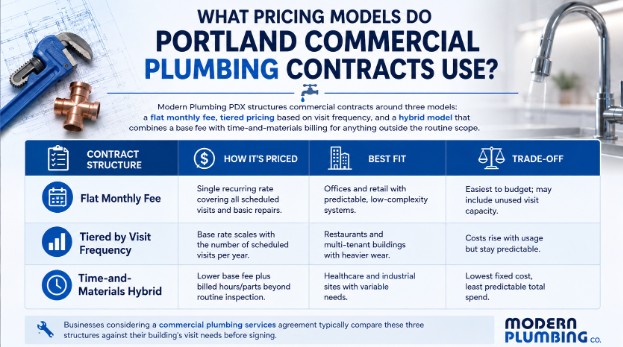
Modern Plumbing PDX structures commercial contracts around three models: a flat monthly fee, tiered pricing based on visit frequency, and a hybrid model that combines a base fee with time-and-materials billing for anything outside the routine scope.
Businesses considering a commercial plumbing services agreement typically compare these three structures against their building’s visit needs before signing.
| Contract Structure | How It’s Priced | Best Fit | Trade-Off |
| Flat Monthly Fee | Single recurring rate covering all scheduled visits and basic repairs | Offices and retail with predictable, low-complexity systems | Easiest to budget; may include unused visit capacity |
| Tiered by Visit Frequency | Base rate scales with number of scheduled visits per year | Restaurants and multi-tenant buildings with heavier wear | Costs rise with usage but stay predictable |
| Time-and-Materials Hybrid | Lower base fee plus billed hours/parts beyond routine inspection | Healthcare and industrial sites with variable needs | Lowest fixed cost, least predictable total spend |
Contract pricing moves on measurable factors rather than a flat per-square-foot rate. Building size and fixture count set the baseline, and industry type and compliance load adjust it from there.
More restrooms, floor drains, and water fixtures mean more inspection points per visit, which raises labor time regardless of contract structure. A single-floor office generally costs less to service than a three-story building with a comparable footprint but a higher fixture count.
Restaurants generate FOG (fats, oil, and grease) that require interceptor cleaning on a schedule set by the city, adding a recurring line item most office contracts don’t include.
Healthcare facilities may incur an additional premium tied to medical gas lines and stricter documentation requirements, though the exact premium depends on the facility’s specific systems.
Portland City Code and Oregon law require backflow prevention assemblies — and annual testing of them — on properties with an irrigation system, a fire sprinkler system, or other cross-connection, which applies to many, but not all, commercial properties.
The city sets separate minimum cleaning frequencies for grease interceptors: hydromechanical units at least every 30 days and gravity interceptors at least every 90 days, with more frequent service required if usage demands it.
Contracts that bundle this documentation cost more than ones that leave compliance scheduling to the business.
Regional labor cost is background context for every quote. The Portland-Vancouver-Hillsboro metro area’s mean hourly wage across all occupations ran above the national average in the most recent Bureau of Labor Statistics release.
That figure covers all occupations, not plumbing specifically, so it’s offered as general regional context rather than a plumbing-labor benchmark.
If you’re ready to get started, call us now!
Reactive repairs typically cost more than a scheduled contract visit. Modern Plumbing PDX structures contracts around what’s covered on the flat fee and what gets billed separately — schedule a consultation to see where a property falls.
| Category | Typically Included | Typically Billed Separately |
| Inspections | Scheduled drain, pipe, and water heater checks | One-off diagnostic visits outside the schedule |
| Compliance | Annual backflow testing and documentation | ADA-specific accessibility upgrades |
| Minor Repairs | Small leaks, valve adjustments, fixture tightening | Water heater replacement or full unit swaps |
| Major Repairs | Priority scheduling for larger issues | Sewer line repair or replacement |
| Emergency Response | Discounted rate in some contracts | Standard emergency premium in others |
A written scope of work should list every system and building location covered, along with what triggers a separate work order. A clearly documented scope is the most reliable way to avoid billing disputes once the contract is in place.
Modern Plumbing PDX bills emergency calls at 1.5 to 2.5 times its standard hourly rate, with weekend and holiday work at the higher end of that range.
A contract doesn’t eliminate emergencies, but scheduled visits are built to catch failing components — a corroding valve, a slow leak — before they turn into an after-hours call.
Businesses that rely on emergency plumbing response without a contract in place pay the full premium rate for every after-hours dispatch, with no priority scheduling tied to an existing relationship.
That’s the core financial argument for a contract: a predictable monthly cost against a variable emergency premium.
Restaurants tend to generate more service calls than offices, largely due to higher water volume and grease-related blockages, which shifts the economics further toward a contract specifically for restaurant plumbing operations.
Every commercial plumbing contractor working in Portland must hold a license through the Oregon Construction Contractors Board, and businesses should confirm the license number and provide proof of general liability insurance before signing anything.
A contractor without proper licensing or insurance places the business at risk if work goes wrong.
Beyond licensing, a business should confirm in writing: the exact scope of covered systems, visit frequency, what’s excluded from the flat fee, response-time guarantees for emergencies, and the renewal or cancellation notice period. Businesses managing multiple compliance requirements can cross-reference Modern Plumbing PDX’s compliance checklist against a proposed contract’s scope to spot gaps before signing.
Medical facilities and other regulated properties should also confirm that medical facility plumbing experience is specifically listed in a contractor’s background, since general commercial experience doesn’t always cover facility-specific requirements such as medical gas lines.
Modern Plumbing PDX prices commercial service contracts at $200 to $2,000 per month in the Portland area, based on building size, industry type, and compliance load.
Flat monthly, tiered, and time-and-materials hybrid structures each fit different building profiles.
Backflow testing and grease interceptor service are governed by Portland City Code and BES rules, not just contractor preference, so confirming a contract’s compliance scope in writing matters as much as confirming price.
Reactive repairs cost more than planned visits, and downtime adds up fast. Modern Plumbing PDX builds contract pricing around each property — schedule a consultation.
How much does a commercial plumbing service contract cost in Portland?
Modern Plumbing PDX prices commercial service contracts at $200 to $2,000 per month. Small offices fall near the lower end; multi-tenant buildings, restaurants, and healthcare facilities with heavier compliance needs and higher fixture counts land toward the upper end of that range.
What’s the difference between a maintenance contract and hourly billing?
A maintenance contract sets a flat, recurring fee that covers scheduled inspections and basic repairs. Hourly billing charges $75 to $150 per hour only when a technician is dispatched for a specific problem; scheduled visits or priority response are not included in that rate.
What does a typical Portland commercial plumbing contract include?
A typical contract covers scheduled inspections, drain and water heater checks, backflow testing, and priority repair scheduling. Visit frequency and exact scope vary by agreement, so businesses should confirm which systems, fixtures, and buildings are covered before signing.
What’s usually billed separately from a flat monthly contract fee?
Capital replacements, such as a full water heater swap or sewer line replacement, are typically billed separately from the flat contract fee. After-hours emergency dispatch may also fall outside standard coverage unless the contract specifically names a discounted emergency rate.
How often do backflow devices and grease interceptors need service in Portland?
Portland City Code requires annual testing of backflow prevention assemblies where installed. The city separately sets minimum grease interceptor cleaning frequencies of at least every 30 days for hydromechanical units and every 90 days for gravity interceptors, more often if usage requires it.
Does a service contract cover emergency or after-hours calls?
Coverage varies by agreement. Some Modern Plumbing PDX contracts bundle a discounted emergency rate or priority response window into the monthly fee; others treat after-hours calls as a separate billable service at the standard emergency rate. Confirm emergency terms in writing before signing.
How does building type affect commercial plumbing contract pricing?
Restaurants generally cost more to service than offices because of grease interceptor cleaning requirements, and healthcare facilities may carry an added premium tied to medical gas lines and documentation. Building age and fixture count also affect price, since older or larger systems take more inspection time per visit.
What should a business ask before signing a commercial plumbing contract?
Businesses should ask for a written scope of work, visit frequency, what’s excluded from the flat fee, response-time guarantees, and renewal or cancellation terms. Confirming Oregon CCB licensing and insurance coverage before signing protects against unlicensed or underinsured contractors performing commercial work.
Is a commercial plumbing service contract worth it for a small office?
A service contract can benefit a small office if it prevents even one unplanned repair, since a scheduled visit generally costs less than an urgent after-hours dispatch. Offices with simple systems and low fixture counts may qualify for pricing near the lower end of the range.
Does every commercial property in Portland need backflow prevention?
Not every property. Portland City Code and Oregon law require a backflow prevention assembly on properties with an irrigation system, fire sprinkler system, or other cross-connection risk. Many but not all commercial properties fall under this requirement, so applicability depends on the building’s systems.
Quick Links
Plumbing Services
SW Washington Service Areas
Oregon Service Areas