

Originally published: August 2026

Commercial water heater replacement in Portland involves more than swapping a residential-sized unit: capacity sizing, the commercial permit process, and seismic code compliance all factor into the project before a technician disconnects the old tank.
Cost varies too widely by building type, fuel source, and venting complexity to quote from a single flat number, which is why water heater replacement projects are typically priced after a free on-site assessment.
The sections below cover what drives that price, what Oregon and Portland code require for commercial properties specifically, and how to plan around the downtime a replacement causes.
An unplanned water heater failure disrupts operations on the business’s schedule, not a chosen one. Modern Plumbing PDX assesses on-site capacity and code requirements before quoting a replacement — request a quote.
Commercial water heater replacement costs more than a residential swap, primarily because commercial units have larger tank or flow capacity, often require gas line or electrical service upgrades, and may need venting modifications that a standard residential installation doesn’t require.
Building type matters as much as unit size: a single-tenant office replacing a 50-gallon unit faces a very different job than a restaurant or a multi-unit building replacing a high-recovery system that feeds several fixtures at once.
Because the spread is wide, Modern Plumbing PDX prices commercial water heater replacements after a free on-site assessment of the property’s capacity needs, fuel type, and code requirements, rather than quoting from a general range.
That assessment is the most reliable way to get a number that reflects the actual building.
Commercial buildings size replacement water heaters around peak demand rather than average daily use. A restaurant kitchen, a multi-unit apartment building, and a single-story office draw hot water in different patterns, which affects whether a tank or tankless system — and what capacity — fits.
Tank systems store a set volume of heated water and recover at a fixed rate, which generally suits buildings with predictable, spread-out demand.
Tankless systems heat water on demand and are sized by flow rate rather than storage volume; whether one fits a high-draw building like a restaurant kitchen depends on the building’s specific simultaneous-flow needs, temperature rise, and available gas or electrical capacity, not the building type alone.
Some higher-demand commercial properties use multiple units in parallel rather than a single large tank, which can also provide redundancy if one unit needs service — the specific configuration is something a contractor evaluates based on the building’s actual demand pattern.
If you’re ready to get started, call us now!
Oregon classifies a water heater as a pressure vessel, and a permit is required for any installation or replacement.
For one- and two-family dwellings, a licensed contractor can use Oregon’s streamlined minor-label permit process — but that program is explicitly limited to residential one- and two-family dwellings; anything larger, including commercial buildings, is excluded and follows the standard permit and inspection process instead.
Commercial properties in Portland follow the commercial plumbing permit process, with fees based on the scope of work described in the application.
| Requirement | Applies When | Source |
| Commercial plumbing permit | Every commercial water heater installation or replacement | Portland Permitting & Development |
| Seismic strapping | Required in Oregon’s applicable seismic design categories | Oregon Plumbing Specialty Code / Oregon BCD |
| Drain pan | Conditional — required where a leak could cause damage, such as above occupied space | Oregon Plumbing Specialty Code |
| Relief valve and venting | Conditional — depends on unit type, fuel source, and installation location | Oregon Plumbing Specialty Code |
The Oregon Plumbing Specialty Code governs the technical standards for these requirements, and a state interpretation memo on seismic strapping sets the anchoring and strap placement standards.
Because drain-pan, relief-valve, and venting requirements depend on the specific unit and installation, a licensed contractor pulling the commercial permit and handling inspection sign-off is the most direct way to confirm exactly what applies to a given building.
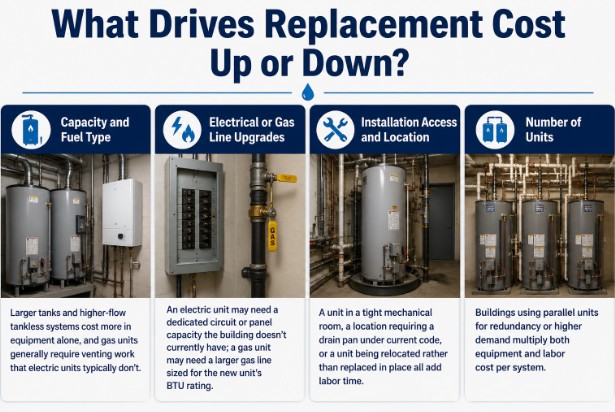
Beyond the unit itself, several building-specific factors shift a commercial water heater replacement quote.
Capacity and fuel type. Larger tanks and higher-flow tankless systems cost more in equipment alone, and gas units generally require venting work that electric units typically don’t.
Electrical or gas line upgrades. An electric unit may need a dedicated circuit or panel capacity the building doesn’t currently have; a gas unit may need a larger gas line sized for the new unit’s BTU rating.
Installation access and location. A unit in a tight mechanical room, a location requiring a drain pan under current code, or a unit being relocated rather than replaced in place all add labor time.
Number of units. Buildings using parallel units for redundancy or higher demand multiply both equipment and labor cost per system.
Businesses managing multiple compliance touchpoints alongside a replacement can cross-reference Modern Plumbing PDX’s compliance checklist to confirm nothing else is due at the same time as the permit inspection.
If you’re ready to get started, call us now!
A commercial water heater replacement takes a system offline for part of the work — the exact duration depends on unit size, installation complexity, and whether the commercial permit inspection is scheduled separately from the installation itself, so it’s worth confirming a specific timeline with the contractor rather than assuming a standard one.
Restaurant kitchens depend on hot water for dishwashing and sanitation throughout service hours, and medical facilities may have sterilization or patient-care needs that make an interruption more disruptive than it would be for a typical office.
Scheduling the replacement during the building’s own lowest-demand hours, rather than a generic off-peak window, reduces operational impact.
Buildings with parallel water heater units can sometimes keep one online while the other is replaced, avoiding a full shutdown — whether that’s workable depends on how the existing system is configured.
Confirming the contractor’s estimated timeline in writing before work begins, including when the commercial permit inspection is scheduled relative to the install, helps a business plan staffing and operations around a specific window instead of an open-ended one.
A few basics on hand before the assessment shortens the process and improves quote accuracy.
That generally includes: the existing unit’s age, capacity, and fuel type if known; the building’s typical hours of operation and any windows when hot water use is lowest; access details for the mechanical room or install location; and any known issues with the current system, such as inconsistent temperature or recent repairs.
Facility managers evaluating multiple properties may also want floor plans or prior permit records on hand if the building has them.
Every commercial plumbing contractor performing a water heater replacement in Portland must be licensed to pull the required commercial permit and handle inspection sign-off.
Confirming that license, along with proof of insurance, protects the business if the installation doesn’t pass inspection or needs correction.
Beyond licensing, a business should confirm: whether the contractor is quoting based on an on-site capacity assessment rather than a generic estimate, what fuel type and capacity the replacement unit is sized for, who handles the permit application and inspection scheduling, and what warranty applies to both the unit and the installation labor — warranty terms vary by manufacturer and installer, so getting both in writing avoids disputes later.
Businesses on a maintenance program can also ask whether annual inspections are already tracking the water heater’s condition, which can flag replacement timing before a failure forces an emergency call.
Commercial water heater replacement in Portland is priced based on capacity, fuel type, and installation complexity rather than a flat rate, since building types vary too widely for a single figure.
Oregon requires a commercial permit and seismic strapping for every replacement; the drain pan, relief valve details, and venting requirements depend on the unit and installation.
Planning the replacement around a building’s lowest-demand hours and confirming licensing, permit handling, and warranty terms in writing keep both cost and downtime as predictable as the project allows.
Modern Plumbing PDX assesses on-site capacity and code requirements before quoting a commercial replacement — schedule a consultation.
How much does commercial water heater replacement cost in Portland?
Cost varies too widely across capacity, fuel type, and installation complexity to provide a single figure. Commercial units generally cost more than residential replacements due to larger capacity, potential gas or electrical upgrades, and venting work. Modern Plumbing PDX quotes after a free on-site assessment.
Does a commercial water heater replacement require a permit in Portland?
Yes. Oregon classifies water heaters as pressure vessels requiring a permit for any installation or replacement. Commercial buildings use the standard commercial plumbing permit and inspection process, not the streamlined minor-label path, which applies only to one- and two-family dwellings.
Can a commercial water heater replacement use Oregon’s minor-label permit process?
No. Oregon’s minor-label program for water heaters is explicitly limited to one- and two-family dwellings. Commercial buildings, regardless of size, are excluded and require the standard commercial permit application and inspection process instead.
Are seismic straps required on commercial water heaters in Portland?
Oregon’s plumbing code requires water heaters to be anchored or strapped in the state’s applicable seismic design categories. A licensed contractor confirms the specific strap placement and anchoring method required for a given building and location.
Should a commercial building choose a tank or tankless water heater?
It depends on the building’s specific demand pattern rather than its type alone. Tank systems generally suit predictable, spread-out hot water use; tankless systems suit high, variable peak draw, but suitability depends on available gas or electrical capacity and simultaneous-flow needs.
How long does a commercial water heater replacement take?
Duration depends on unit size, installation complexity, and whether code upgrades like a new drain pan are needed, so it varies by project. Confirming a specific estimated timeline with the contractor, including permit inspection scheduling, is more reliable than assuming a standard duration.
Can a building avoid a full hot water shutdown during replacement?
Buildings using parallel water heater units can sometimes keep one online while the other is replaced, depending on how the system is configured. Scheduling the work during the building’s own lowest-demand hours also reduces the operational impact for buildings without redundant units.
What should a restaurant or medical facility consider before scheduling a replacement?
These facilities depend on continuous hot water for sanitation or patient care, so scheduling around the building’s own lowest-demand hours and confirming the contractor’s timeline in writing before work begins helps limit disruption to daily operations.
What voids a warranty on a commercial water heater installation?
Warranty terms vary by manufacturer and installer, so a business should confirm in writing what the unit warranty and the installation labor warranty each cover, and what documentation is needed if a claim comes up later.
How does a business know when to replace a water heater instead of repairing it?
Several factors matter together: the unit’s age relative to its expected service life, how often it needs repair, visible corrosion or leaking, declining efficiency, whether replacement parts are still available, and whether current capacity still meets the building’s demand. A professional assessment weighs these against the cost of continued repair.
Quick Links
Plumbing Services
SW Washington Service Areas
Oregon Service Areas