

Originally published: July 2026
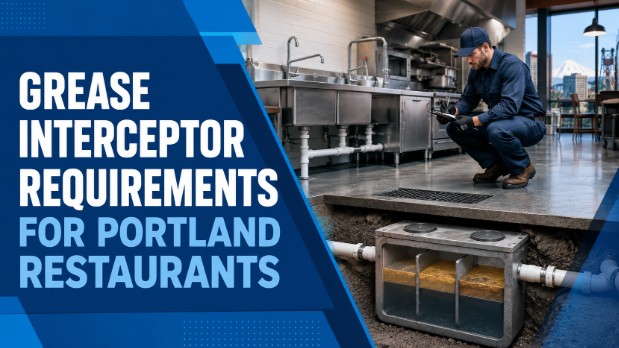
Portland restaurants must connect kitchen fixtures to an approved grease trap and interceptor system under City Code 17.34.050 and the Oregon Plumbing Specialty Code whenever a kitchen undergoes new construction, redevelopment, tenant improvement, or a change in ownership.
The Bureau of Environmental Services (BES) enforces installation through the Cut Through the FOG program and issues a written notice giving affected restaurants a 90-day window to install a hydromechanical grease interceptor (HGI) or an 180-day window to install a gravity grease interceptor (GGI).
A missed 90-day deadline can trigger sewer-blockage fines fast. Modern Plumbing installs code-compliant grease interceptors for Portland kitchens — request your compliance walkthrough before your window closes.
City Code Chapter 17.34 gives the Bureau of Environmental Services authority to require pretreatment of restaurant wastewater before it reaches the sanitary sewer.
Section 17.34.050 specifically lets the BES director require dischargers to install treatment facilities or make structural modifications, with compliance deadlines tied to construction time and the discharge’s impact on the sewer system.
BES implements this authority through Administrative Rule ENB-4.26, which adopts the Oregon Plumbing Specialty Code as the governing plumbing standard for interceptor design and installation.
Portland restaurant owners cannot satisfy 17.34.050 with additives or chemical treatments; ENB-4.26 prohibits chemical, enzyme, and bacterial additives in any grease interceptor regardless of composition, because they let FOG pass through into the city sewer system.
If you’re ready to get started, call us now!
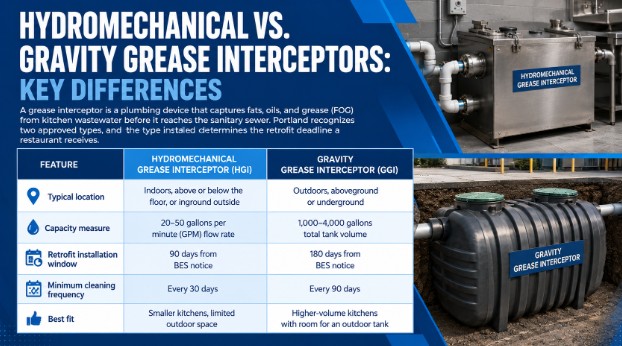
A grease interceptor is a plumbing device that captures fats, oils, and grease (FOG) from kitchen wastewater before it reaches the sanitary sewer. Portland recognizes two approved types, and the type installed determines the retrofit deadline a restaurant receives.
| Feature | Hydromechanical Grease Interceptor (HGI) | Gravity Grease Interceptor (GGI) |
| Typical location | Indoors, above or below the floor, or in-ground outside | Outdoors, aboveground, or underground |
| Capacity measure | 20–50 gallons per minute (GPM) flow rate | 1,000–4,000 gallons total tank volume |
| Retrofit installation window | 90 days from BES notice | 180 days from BES notice |
| Minimum cleaning frequency | Every 30 days | Every 90 days |
| Best fit | Smaller kitchens, limited outdoor space | Higher-volume kitchens with room for an outdoor tank |
Both device types must meet the 25%-full cleaning standard, and both are subject to BES inspection at any time.
The Oregon Plumbing Specialty Code and City Code 17.34.050 trigger a new grease interceptor requirement at four specific points in a restaurant’s lifecycle: new construction, redevelopment of an existing structure, tenant improvement work in the kitchen, and a change in ownership or occupancy.
A restaurant remodeling its kitchen plumbing to add a dishwasher line or expand prep sinks falls under the tenant-improvement trigger even if the interceptor already installed was adequate for the prior layout.
A restaurant changing hands under new ownership triggers the requirement independently of any physical construction, because BES ties the obligation to occupancy changes, not just to permits pulled.
If you’re ready to get started, call us now!
Once BES identifies a facility requiring a new or upgraded interceptor, ENB-4.26 authorizes a temporary discharge variance while installation is underway — capped at 90 days for HGIs and 180 days for GGIs.
A restaurant that causes or contributes to a sewer blockage during this authorized window remains subject to enforcement despite the variance.
Facility operators may request an alternative compliance schedule or appeal the requirement through the variance process described in Section 10 of ENB-4.26, but the appeal must be filed before the deadline, not after.
Documentation confirming the completed installation may be required before BES closes the compliance file.
Restaurants budgeting for grease trap cleaning every 30–90 days as part of routine maintenance should build the same cadence into the installation timeline itself, since permitting and equipment lead times can consume much of a 90-day window before installation even begins.
Racing to a 90-day installation deadline leaves little margin for permitting delays. Modern Plumbing coordinates commercial plumbing services and permit submissions together — call before the clock runs out.
The Cut Through the FOG program sets sewer rates for food service establishments based on water use and documented practices at each business. BES staff visit affected restaurants directly to verify interceptor conditions and share best management practices that can offset rate increases.
More than 3,000 food service establishments across Portland and Lake Oswego pay additional fees under this program because their wastewater requires extra sewer cleaning and treatment compared to typical residential discharge.
Restaurants that document consistent maintenance and stay ahead of BES inspection findings generally see smaller rate increases than restaurants BES must revisit for repeated violations.
Grease interceptor sizing follows a flow-rate method: total the drainage fixture units (DFUs) for every kitchen fixture draining to the device, apply a simultaneity factor since not every fixture runs at once, then match the result to the minimum interceptor capacity the Oregon Plumbing Specialty Code requires.
| Example scenario | Estimated DFUs | HGI size required | GGI size required |
| 40-seat restaurant, ~120 meals/hour | 29 DFUs | 75 GPM unit | 100-gallon unit |
| Smaller-format restaurant, lower fixture count | Fewer DFUs | 50 GPM unit | 750-gallon unit |
These figures illustrate the sizing methodology; the exact required capacity for any Portland kitchen depends on the fixture count BES and a plan reviewer confirm during permitting, so restaurants should submit fixture schedules before ordering equipment.
Restaurants must pump their interceptor once FOG and solids reach 25% of the unit’s liquid depth, and BES requires maintenance reports within 14 days of every cleaning. Facility operators bear ultimate responsibility for these records even when a third-party hauler performs the actual pumping.
Restaurants tracking multiple compliance obligations at once — grease interceptors alongside backflow prevention and other requirements — often find it easier to use a single plumbing compliance checklist rather than manage each deadline separately, since backflow testing and grease interceptor reporting frequently fall within overlapping annual cycles.
A poorly maintained interceptor that causes sewer line blockages can shut down a kitchen’s restrooms and prep sinks within minutes, so restaurants should treat interceptor maintenance as inspection-critical rather than optional upkeep.
Restaurants without an established plumbing partner should review a hiring-a-plumbing-contractor checklist before signing a maintenance contract, since not every commercial plumber is familiar with BES reporting requirements.
Does every Portland restaurant need a grease interceptor?
Most food service establishments that discharge FOG-containing wastewater need one under City Code 17.34.050 and the Oregon Plumbing Specialty Code. The requirement applies to new construction, redevelopment, tenant improvement, or ownership change — BES confirms specifics during plan review.
What happens if I miss the 90-day HGI installation deadline?
Missing the deadline ends your temporary discharge authorization under ENB-4.26. BES can pursue enforcement, and any sewer blockage caused during the lapsed period remains your responsibility even though the variance had been in place.
Can I request more time to install a grease interceptor?
Yes. ENB-4.26 allows a facility operator to request an alternative compliance schedule through the variance process described in Section 10, but the request must be filed with BES before the original deadline expires.
How often does my interceptor need cleaning?
BES requires cleaning once FOG and solids reach 25% of the liquid depth, translating to roughly every 30 days for HGIs and every 90 days for GGIs at a minimum, though high-volume kitchens often need more frequent service.
Can I use chemical additives instead of pumping my interceptor?
No. ENB-4.26 prohibits chemical, enzyme, and bacterial additives in any grease interceptor because they let FOG pass through into the city sewer, potentially damaging pipes and violating your discharge authorization under Chapter 17.34.
Who inspects grease interceptors in Portland?
BES staff conduct routine inspections, which may include system sampling. Inspectors verify interceptor condition, pumping frequency, and maintenance documentation and can issue citations for deficiencies found during any scheduled or unannounced visit.
Does changing restaurant ownership trigger a new interceptor requirement?
Yes. The Oregon Plumbing Specialty Code ties the grease interceptor requirement to occupancy and ownership changes independently of construction activity, meaning a new owner inherits the compliance obligation even without remodeling the kitchen.
How does Cut Through the FOG affect my sewer bill?
The program bases your sewer rate on water use and documented practices at your restaurant. BES staff visits verify conditions, and following best management practices can help offset the rate increases that apply to food service establishments.
Don’t wait for a BES notice to start the clock. Modern Plumbing handles restaurant plumbing needs across Portland — schedule your grease interceptor assessment before your next inspection.
Quick Links
Plumbing Services
SW Washington Service Areas
Oregon Service Areas