

Originally published: September 2026

Common plumbing failures in Portland apartment complexes cluster into four categories: sewer backups in shared drain lines, supply-pipe leaks in aging risers, hot water loss from central heating equipment, and failed backflow assemblies.
Each can affect multiple units at once, which separates multi-family plumbing from single-unit repair. Apartment buildings from Portland’s mid-century construction periods often retain original clay, cast-iron, or galvanized piping.
Modern Plumbing Co. performs commercial plumbing for multi-tenant buildings across the Portland metro area.
Repeat backups and tenant complaints drain a maintenance budget fast. Modern Plumbing Co. diagnoses multi-family plumbing failures at the source — schedule a Portland assessment.
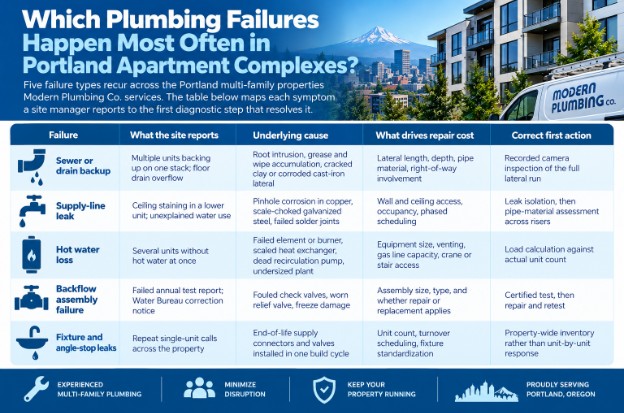
Five failure types recur across the Portland multi-family properties Modern Plumbing Co. services: sewer and drain backups, supply-line leaks, hot water loss, backflow assembly failure, and fixture or angle-stop leaks that spread between floors.
The table below maps each symptom a site manager reports to the first diagnostic step that resolves it.
| Failure | What the site reports | Underlying cause | What drives repair cost | Correct first action |
| Sewer or drain backup | Multiple units backing up on one stack; floor drain overflow | Root intrusion, grease and wipe accumulation, cracked clay or corroded cast-iron lateral | Lateral length, depth, pipe material, right-of-way involvement | Recorded camera inspection of the full lateral run |
| Supply-line leak | Ceiling staining in a lower unit; unexplained water use | Pinhole corrosion in copper, scale-choked galvanized steel, failed solder joints | Wall and ceiling access, occupancy, phased scheduling | Leak isolation, then pipe-material assessment across risers |
| Hot water loss | Several units without hot water at once | Failed element or burner, scaled heat exchanger, dead recirculation pump, undersized plant | Equipment size, venting, gas line capacity, crane or stair access | Load calculation against actual unit count |
| Backflow assembly failure | Failed annual test report; Water Bureau correction notice | Fouled check valves, worn relief valve, freeze damage | Assembly size, type, and whether repair or replacement applies | Certified test, then repair and retest |
| Fixture and angle-stop leaks | Repeat single-unit calls across the property | End-of-life supply connectors and valves installed in one build cycle | Unit count, turnover scheduling, fixture standardization | Property-wide inventory rather than unit-by-unit response |
Four of the five originate in shared infrastructure.
In Modern Plumbing Co.’s multi-family diagnostic practice, a property logging the same complaint from different units is more often looking at one defect than several — though buildings that have absorbed piecemeal repairs over decades can carry genuinely separate faults on the same system, which is what camera inspection settles.
If you’re ready to get started, call us now!
Older Portland apartment buildings leak because the original supply piping has passed its service life while the building’s water demand has not decreased. Galvanized steel scales inward until flow drops and joints weep.
Copper develops pinhole perforations where thin-wall tubing meets high velocity and long-run water chemistry.
Portland’s water supply is part of that picture. The Portland Water Bureau brought Improved Corrosion Control Treatment online at the Lusted Hill Facility in April 2022, raising pH and alkalinity to reduce corrosion of metals in building plumbing, as documented on the Bureau’s corrosion control project page.
That treatment reduces future metal loss. It does not restore wall thickness already lost in piping installed decades earlier, which is why buildings that predate the treatment change continue to produce leak calls.
Three conditions separate a repairable leak from a repiping decision, and Modern Plumbing Co. weighs all three before quoting either:
Phased repiping keeps most buildings occupied. Work runs one stack at a time with scheduled shutoff windows and advance tenant notice, though buildings with single-source risers or no isolation valves can require broader outages.
Modern Plumbing Co. has been diagnosing this failure pattern in Portland-area buildings for four generations.
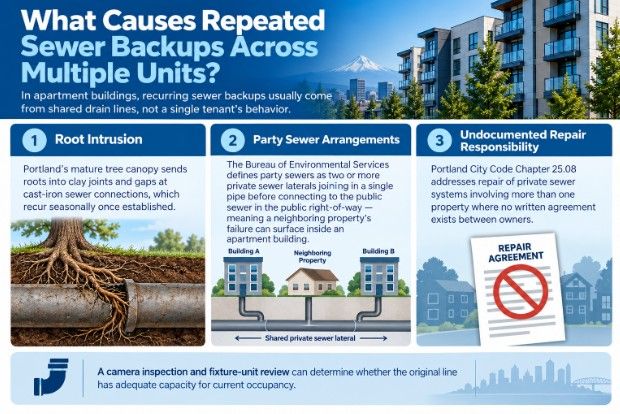
Repeated sewer backups in an apartment complex typically trace to the building’s shared drain infrastructure rather than to tenant behavior in any single unit.
A stack serving eight or twelve apartments carries every wipe, grease pour, and hair mat from all of them into one lateral, and that combined load concentrates wear at the lateral’s weakest joints.
Whether the original line has adequate capacity for current occupancy is a building-specific question that camera inspection and fixture-unit review answer, not one that pipe age alone settles.
Three conditions drive the pattern in Portland specifically:
Pipe ownership determines who pays. Portland City Code Section 17.32.070 limits City lateral maintenance to defined segments — for a City-paved street with curbs, from the sewer main to the street-side curb face — and assigns the remaining portions to the property owner receiving service through the lateral.
Modern Plumbing Co. runs a camera inspection before recommending commercial hydro jetting, because jetting a structurally compromised line clears the blockage without addressing the defect that produced it.
When the camera shows cracked joints rather than accumulation, cleaning becomes a recurring expense. Trenchless sewer repair rehabilitates the lateral without trenching parking areas or courtyards, which matters on a property where residents park daily.
An apartment building loses hot water across multiple units because a single plant serves those units. One failed component removes service from every apartment downstream, unlike a single-family failure that affects one household.
Five causes recur in Modern Plumbing Co.’s multi-family work:
Capacity is the cause property managers most often misread as equipment failure. Replacing the same unit with the same capacity repeats the problem.
Modern Plumbing Co. runs a load calculation based on actual unit count and fixture inventory before quoting commercial water heater replacement, so owners don’t pay twice for the same shortfall.
If you’re ready to get started, call us now!
Portland apartment buildings require premises-isolation backflow protection, and multi-tenant properties fall into the highest-protection category.
The Portland Water Bureau’s backflow assembly installation requirements, effective July 25, 2025, set out what applies:
The shutoff provision reframes backflow compliance as an occupancy risk rather than a paperwork task.
A shutoff at a multi-family property removes an essential service from every tenant at once, turning a missed test deadline into a habitability problem within hours.
Modern Plumbing Co. installs and services backflow prevention devices for Portland commercial and multi-tenant properties, and its guidance on a failed backflow test covers the repair-and-retest sequence that follows a failure.
A failed backflow test can put an entire apartment building’s water service at risk. Modern Plumbing Co. handles repair and retest — request certified backflow service.
Oregon law does not set one universal repair deadline. It sets a standing habitability duty and attaches faster tenant remedies to failures of essential services, including plumbing and running water.
The Oregon Residential Landlord and Tenant Act, Chapter 90, governs all three provisions below.
| Statute | What it covers | Practical effect on a plumbing failure |
| ORS 90.320 | Landlord duty to maintain the dwelling unit in habitable condition, including plumbing facilities maintained in good working order and a water supply capable of producing hot and cold running water | Establishes the baseline obligation; a chronic hot water or drainage defect is a habitability question, not a service preference |
| ORS 90.360 | Tenant remedies for landlord noncompliance with the rental agreement or the obligation to maintain premises | Applies to defects that fall short of an essential-service failure, following written tenant notice |
| ORS 90.365 | Landlord failure to supply an essential service | After written notice specifying the breach, the tenant may seek substitute services, diminution in rent damages, or substitute housing |
Response time therefore carries exposure beyond the repair invoice, and a building without running water generates that exposure across every affected unit at once.
Modern Plumbing Co.’s guidance on building an emergency plumbing response plan covers establishing a named contractor relationship before a failure occurs.
Property managers reduce emergency calls by replacing reactive dispatch with a scheduled inspection cycle tied to the building’s actual pipe material and age.
Portland’s multi-family stock rewards this because most failures announce themselves months before they become emergencies.
Modern Plumbing Co. structures commercial plumbing maintenance programs around these intervals, and pairs them with scheduled drain cleaning for buildings with a documented backup history, so owners can budget the work rather than absorb it at after-hours rates.
What are the most common plumbing failures in Portland apartment complexes?
Sewer backups in shared drain lines, supply-pipe leaks in aging risers, hot water loss from central heating equipment, failed backflow assemblies, and end-of-life fixture connectors are the failure types Modern Plumbing Co. encounters repeatedly in Portland multi-family buildings. Each affects multiple units at once.
Does a Portland apartment building need a backflow prevention assembly?
Yes. The Portland Water Bureau requires a reduced pressure–type assembly on domestic water services to multi-tenant premises, and a certified tester must test every required assembly annually. Refusing installation, testing, or maintenance can result in water service shutoff.
How fast must an Oregon landlord repair a plumbing problem?
Oregon law does not fix a single deadline. ORS 90.320 requires plumbing facilities be maintained in good working order, and ORS 90.365 gives tenants remedies after written notice when the landlord fails to supply an essential service such as running water.
Who pays for a sewer lateral repair at a Portland apartment property?
The property owner pays for the private lateral serving the building. Portland City Code Section 17.32.070 limits City maintenance to defined segments in the right-of-way; remaining lateral portions belong to the owner receiving service through that lateral. Camera inspection confirms the split.
What is a party sewer, and why does it matter for apartment owners?
A party sewer joins two or more private laterals into one pipe before it reaches the public sewer. Portland classifies that arrangement as a nonconforming sewer, and repair responsibility is shared among the connected properties rather than carried by the City.
Why do several units lose hot water at the same time?
Central water heating serves multiple units from one plant. A failed heating element, a stuck mixing valve, a scaled heat exchanger, or a dead recirculation pump removes hot water from every unit downstream at once rather than from a single apartment.
Are pinhole leaks in copper pipe common in Portland buildings?
Copper pinhole leaks appear in older Portland buildings where thin-wall tubing, high velocity, and water chemistry combine. Portland Water Bureau brought Improved Corrosion Control Treatment online in April 2022, raising pH and alkalinity to reduce metal corrosion in building plumbing.
How often should an apartment complex have its sewer lines cleaned?
Scheduling depends on building age, pipe material, and fixture load, not a single interval. Buildings with clay or cast-iron laterals and recurring backups benefit from camera inspection first, which shows whether cleaning, hydro jetting, or lining is the correct response.
Can an apartment building be repiped while tenants stay in their units?
Usually, yes. Repiping runs in phases, one riser or stack at a time, with water shut off for scheduled windows and tenant notice before each phase. Buildings lacking isolation valves or with single-source risers can require broader outages.
What determines the cost of a multi-family plumbing repair in Portland?
Scope drives cost more than the fixture involved. Pipe material, run length, access through occupied units, whether work enters the public right-of-way, permit requirements, and after-hours scheduling each change the final figure. Camera diagnosis sets the scope.
Four generations of Portland plumbers have worked on buildings like these since 1959. Modern Plumbing Co. answers with a live person — start a multi-family conversation.
Quick Links
Plumbing Services
SW Washington Service Areas
Oregon Service Areas