

Originally published: October 2026

Reviewed by: Modern Plumbing Co., a Tualatin, Oregon plumbing firm run by one family for four generations, for inspection scope and Portland plumbing rules; transaction terms belong with a broker or attorney.
Commercial plumbing due diligence is the inspection and records review a buyer or tenant completes before committing to a commercial property, so plumbing defects surface while price and lease terms are still open.
In Portland, that review covers five areas: interior supply and drain piping, the sewer lateral, water heating equipment, backflow and grease compliance records, and permit history.
A commercial plumbing inspection done before closing or signing turns hidden repair costs into negotiating points.
Post-closing defects usually fall to the new owner unless the agreement says otherwise. Modern Plumbing Co. offers commercial inspections and a free repair estimate.
A commercial plumbing inspection before purchase should cover a standard system review, plus deeper testing where age, use, or records raise questions. Modern Plumbing Co.’s plumbing system inspection covers:
For a more in-depth assessment, the company also offers sewer camera inspection, backflow device testing, water heater inspection, and gas piping inspection, followed by a written report of findings and recommended repairs.
Buyers should confirm in writing which services are included; backflow tests require a State of Oregon certified tester.
Buyers usually scope the whole building, subject to access; tenants can focus on systems tied to their space and lease.
Buyers and tenants should gather records showing how the building was maintained and whether past work was permitted.
Permit history is public through the City’s Portland Maps permit search. The rest come from the seller or landlord, subject to the purchase agreement or lease:
Missing records become negotiating points: a buyer can request backflow testing before closing, extend the inspection, or price the unknown into the offer.
The sewer lateral needs its own review because Portland assigns most private sewer piping to property owners, and buried repairs are costly.
Portland City Code 17.32.070 assigns maintenance by system type. Parties served by a private system the City did not build or accept must maintain it, even in the right-of-way.
For City-accepted laterals, the City maintains defined segments, such as main to curb face on a paved street with curbs, and the property owner receiving service maintains the rest. The boundary of sewer lateral responsibility shifts with street type.
Shared lines add risk. Portland’s nonconforming sewer program covers party sewers serving several properties, laterals crossing another lot without a recorded easement, and private lines in the right-of-way.
Owners often do not know these conditions exist. City Code 17.33.030 requires conversion or abandonment once the City gives notice, so buyers should ask Environmental Services about any open notice before closing.
A sewer camera inspection documents the pipe’s interior condition, such as cracks, root intrusion, and offset joints. It does not prove the line’s full route, ownership, or legal status; you need locating, sewer maps, easement records, and City confirmation.
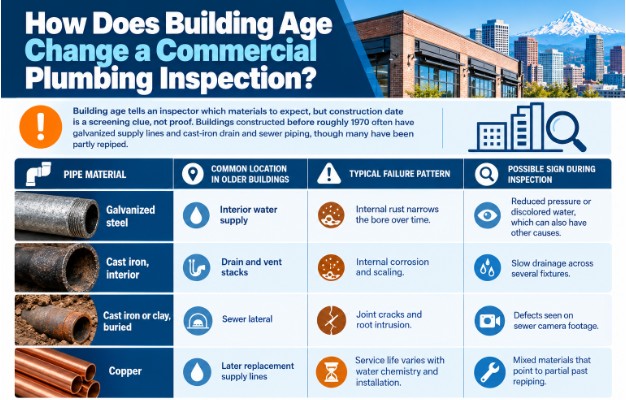
Building age tells an inspector which materials to expect, but construction date is a screening clue, not proof. Buildings constructed before roughly 1970 often have galvanized supply lines and cast-iron drain and sewer piping, though many have been partly repiped.
| Pipe Material | Common Location in Older Buildings | Typical Failure Pattern | Possible Sign During Inspection |
| Galvanized steel | Interior water supply | Internal rust narrows the bore over time | Reduced pressure or discolored water, which can also have other causes |
| Cast iron, interior | Drain and vent stacks | Internal corrosion and scaling | Slow drainage across several fixtures |
| Cast iron or clay, buried | Sewer lateral | Joint cracks and root intrusion | Defects seen on sewer camera footage |
| Copper | Later replacement supply lines | Service life varies with water chemistry and installation | Mixed materials that point to partial past repiping |
The amount of aging pipe in pre-1970 buildings determines whether a buyer prices in a partial repipe, a full repipe, or neither. Material findings cover accessible areas such as basements, mechanical rooms, and ceiling spaces; piping inside finished walls is judged from indirect signs.
Original galvanized piping can be hidden behind new drywall. Modern Plumbing Co. identifies pipe material and condition during a commercial plumbing inspection before closing.
If you’re ready to get started, call us now!
Inspection findings support negotiation but do not automatically create a right to a credit or repair. Ownership, maintenance duty, and who pays can differ, and the contract or lease, within applicable law, largely decides payment.
| Finding | Issue Type | Possible Purchase Request | Possible Lease Request |
| Failing sewer lateral | Urgent defect | Price reduction or seller repair before closing | Landlord repair before commencement |
| Missing backflow test reports | Compliance issue | Seller completes testing before closing | Landlord provides passing reports at delivery |
| Unpermitted plumbing alterations | Compliance issue | Seller legalizes the work or credits the cost | Landlord corrects before possession |
| Water heater near end of life | Future capital cost | Credit at closing | Replacement assigned to the landlord in writing |
| Original galvanized supply piping | Future capital cost | Repipe budget reflected in price | Landlord keeps capital replacement in the lease |
A written figure, such as a quote for commercial water heater replacement, carries more weight in negotiation than a general concern.
A plumbing inspection should happen early in the due diligence or inspection contingency period, while the buyer or tenant can still renegotiate or withdraw. A workable sequence:
Legalizing unpermitted work requires Portland’s commercial plumbing permit process, which adds review time. Tenants should inspect before signing, since delivery condition terms lock in at execution.
When a seller or landlord restricts access to mechanical rooms, cleanouts, or occupied suites, the buyer should document the limitation and treat uninspected systems as an unknown cost.
What does a commercial plumbing inspection before purchase include?
A commercial plumbing inspection before purchase typically includes visual checks, leak detection, water pressure testing, and drainage evaluation. Deeper assessments add sewer camera inspection, backflow device testing, water heater inspection, and gas piping inspection. Buyers should confirm which level the inspection report covers.
What should a commercial tenant inspect before signing a lease?
A commercial tenant should inspect plumbing that serves the leased space, supports the planned use, or would become the tenant’s responsibility under the lease. Restaurant tenants should inspect the grease interceptor and backflow assembly, and multi-tenant buildings should review shared drains.
What is a nonconforming sewer in Portland?
A nonconforming sewer is a connection that does not meet Portland’s requirement for a direct, independent link to the public sewer. Examples include party sewers shared by several properties, laterals crossing another lot without an easement, and private lines running under the public right-of-way.
Must a seller provide plumbing records in a Portland commercial sale?
Whether a seller must provide plumbing records depends on the purchase agreement, not on Portland’s plumbing rules. Buyers can still request permit history, backflow reports, cleaning reports, and invoices, and can price missing records into the offer or extend the inspection scope.
How can a buyer check plumbing permit history in Portland?
A buyer can search permit history by address through the City’s Portland Maps permit search. Comparing the permit record against visible plumbing alterations helps identify work done without permits, which may need correction before or after closing depending on the negotiated terms.
Does a building’s age confirm what pipe is installed?
No. A building’s age only suggests likely materials. Pre-1970 Portland commercial buildings often started with galvanized supply lines and cast-iron drains, but many were partly repiped. An on-site inspection of accessible piping is the only way to confirm what remains.
What if a seller limits access during a plumbing inspection?
If a buyer faces limited access, they should get the restriction in writing and note which plumbing systems went uninspected. The buyer can then request an extended contingency, a follow-up inspection before closing, or a price adjustment that reflects the unknown condition.
When should a plumbing inspection happen during a commercial purchase?
A plumbing inspection should happen early in the due diligence or inspection contingency period. Sewer camera work, permit research, and records requests can take several visits, and early findings leave time to renegotiate price or repairs before the contingency expires.
Commercial plumbing due diligence in Portland pairs an on-site inspection with public permit research and seller or landlord records before finalizing price or lease terms. Buyers usually scope the whole building, while tenants focus on systems tied to their space and lease. Findings are sorted into urgent defects, compliance issues, and future capital costs, then used to support negotiated credits, repairs, or lease terms.
Defects found before signing can still be negotiated. Modern Plumbing Co. delivers a pre-purchase or pre-lease written inspection report for Portland commercial properties.
Quick Links
Plumbing Services
SW Washington Service Areas
Oregon Service Areas