

Originally published: October 2026

Reviewed by: Modern Plumbing Co., a Tualatin, Oregon commercial plumbing contractor serving Portland since 1959, for plumbing system and permit accuracy; lease interpretation belongs with an Oregon commercial real estate attorney.
Commercial lease plumbing responsibility is how a commercial lease divides plumbing repair, maintenance, and replacement costs between a landlord and a business tenant.
In Portland, the lease generally governs that split, subject to plumbing codes, City rules, and other applicable law.
Portland City Code separately assigns backflow and private sewer obligations, often to the property owner, regardless of what the lease says.
Work on both sides of that line falls under Portland’s commercial plumbing rules.
A slow drain can turn into a lease dispute. Modern Plumbing Co. can show the problem on video and offer a free estimate.
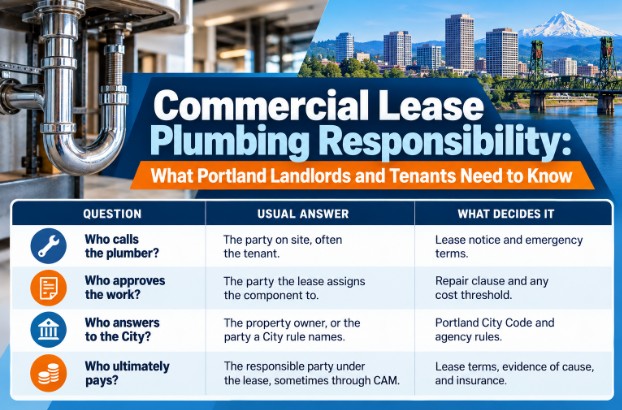
Between landlord and tenant, the lease generally decides who arranges and pays for plumbing repairs in a Portland commercial space. Plumbing codes, Portland City Code, insurance policies, and general contract law still affect how those lease terms apply.
Oregon’s Residential Landlord and Tenant Act requires residential landlords to keep plumbing working and code-compliant under ORS 90.320. That duty applies to dwelling units, not storefronts, offices, or restaurants.
The general tenancy statute, ORS Chapter 91, covers tenancy types, termination notices, and rent. ORS Chapter 91 does not set out a duty to maintain commercial plumbing.
The repair and maintenance clause, the alterations clause, and the common area maintenance (CAM) clause carry most of the allocation. Every repair also raises four separate questions, and the answers do not always point to the same party.
| Question | Usual Answer | What Decides It |
| Who calls the plumber? | The party on site, often the tenant | Lease notice and emergency terms |
| Who approves the work? | The party the lease assigns the component to | Repair clause and any cost threshold |
| Who answers to the City? | The property owner, or the party a City rule names | Portland City Code and agency rules |
| Who ultimately pays? | The responsible party under the lease, sometimes through CAM | Lease terms, evidence of cause, and insurance |
Mixed-use buildings complicate all four answers, because office building plumbing often shares risers, restrooms, and water heaters across suites with different lease terms.
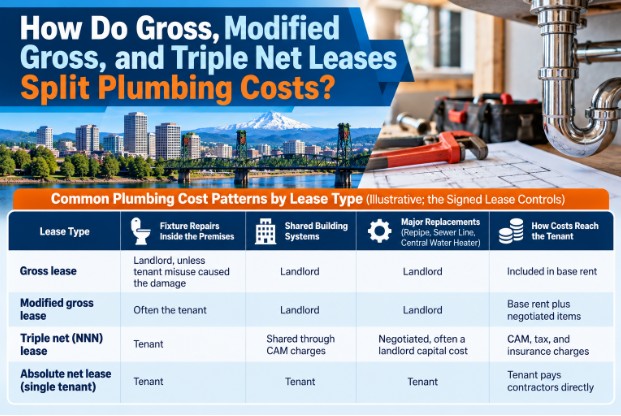
Lease type sets a common starting point. Gross leases tend to keep plumbing repair costs with the landlord. Modified gross leases divide them by component. Triple net leases tend to pass repair and maintenance costs to the tenant. A triple net (NNN) lease is a commercial lease in which the tenant pays property taxes, insurance, and maintenance costs in addition to base rent.
Common Plumbing Cost Patterns by Lease Type (Illustrative; the Signed Lease Controls)
| Lease Type | Fixture Repairs Inside the Premises | Shared Building Systems | Major Replacements (Repipe, Sewer Line, Central Water Heater) | How Costs Reach the Tenant |
| Gross lease | Landlord, unless tenant misuse caused the damage | Landlord | Landlord | Included in base rent |
| Modified gross lease | Often the tenant | Landlord | Landlord | Base rent plus negotiated items |
| Triple net (NNN) lease | Tenant | Shared through CAM charges | Negotiated, often a landlord capital cost | CAM, tax, and insurance charges |
| Absolute net lease (single tenant) | Tenant | Tenant | Tenant | Tenant pays contractors directly |
A lease titled “triple net” can still reserve underground utilities, structural plumbing, and roof drains to the landlord, so the clause text matters more than the lease name.
Tenants carrying plumbing duties under a net lease can schedule a maintenance program to catch failing valves, slow drains, and aging water heaters before they become emergency calls.
Components that serve only one tenant’s premises commonly fall to that tenant. Components that serve the whole building or run underground commonly stay with the landlord. The party responsible to the City and the party paying under the lease can differ.
Common Allocation by Plumbing Component (Illustrative; the Signed Lease Controls)
| Plumbing Component | Common Lease Allocation (Cost) | Party Answerable to the City | What Can Shift the Cost |
| Sinks, toilets, and faucets inside the premises | Tenant | Permit holder, when work needs a permit | Failure traced to building supply or an original defect |
| Branch drain serving one suite | Tenant | Permit holder, when work needs a permit | Blockage found in a shared stack or building drain |
| Shared risers, stacks, and supply mains | Landlord, often recovered through CAM | Permit holder, when work needs a permit | Damage caused by tenant misuse |
| Water heater serving one suite | Tenant for repair; replacement set by the lease | Permit holder, when work needs a permit | Lease names the unit and a replacement threshold |
| Central water heater or boiler | Landlord | Permit holder, when work needs a permit | NNN lease passing the cost through CAM |
| Grease interceptor | Food service tenant for pumping | Food service establishment, under BES rules | Installation or replacement negotiated as a capital cost |
| Backflow assembly | Varies; tenant often reimburses testing | Property owner, plus assembly owner if different | Lease reimbursement terms |
| Private sewer piping | Landlord, sometimes through CAM | Property owners served by the line | Lease pass-through terms |
A backup limited to one suite’s fixtures usually points to that suite’s branch line. Backups appearing at the lowest fixtures of several suites at once usually point to a shared stack or building drain. A camera run from the nearest cleanout, paired with commercial drain cleaning, records where the blockage sits, giving the parties evidence to apply the lease.
Portland City Code assigns backflow protection to property owners and private sewer maintenance to the parties each system serves. Bureau of Environmental Services (BES) rules direct grease interceptor upkeep at food service operators. A lease can shift who pays, but the City enforces against the party its rules name.
Portland City Code 21.30.320 makes the property owner responsible for maintaining required premises-isolation backflow protection, whether the building is occupied or vacant. A State of Oregon-certified tester must test each assembly at least once a year and again after installation, relocation, or repair.
Under that section, the property owner covers repair, testing, and replacement costs, along with the assembly owner if that is a different party.
The Water Bureau can discontinue water service when required protection is missing, untested, or poorly maintained. A lease can require tenant reimbursement, and landlords who delegate the work can ask for a copy of each backflow test report.
Portland City Code 17.32.070 bases sewer maintenance on ownership. Private systems the City did not build or accept belong to the parties they serve, even inside the public right-of-way. For accepted public laterals, the City maintains specific segments, such as the main to curb face on paved streets with curbs, and the property owner maintains the rest.
Shared party sewers and other nonconforming lines change that split, and repairs in the right-of-way need a separate lateral repair permit.
When a privately owned line in the right-of-way becomes a public nuisance, the City can abate it, bill each contributing property, and place a lien if the bill stays unpaid for 30 days.
A lease can keep sewer lateral responsibility with the landlord and allow cost recovery through CAM charges.
Portland’s Bureau of Environmental Services inspects grease interceptors and sets cleaning frequency by establishment type, interceptor size, and flow.
The bureau can cite deficiencies and direct enforcement at the food service establishment that causes a grease obstruction in the City sewer. That business can also face liability for damage to other properties.
These pumping and cleaning duties are operational, so the restaurant tenant running the kitchen handles them. Installing or replacing the interceptor itself is permitted plumbing work tied to the building.
Landlords and restaurant tenants typically negotiate that capital cost in the lease, along with who hires the pumping contractor and who keeps the service records.
Backflow notices and sewer deadlines reach the owner first. Modern Plumbing Co. coordinates backflow testing and handles sewer repair permits across Portland.
If you’re ready to get started, call us now!
A before-you-sign review should confirm that the lease names each plumbing component, sets approval limits, assigns emergency authority, and explains how cause gets established. Each provision below is a negotiated term, not a standard requirement:
Portland’s commercial plumbing permit rules require a licensed plumbing contractor to buy the permit and perform the work when a business operates in a commercial structure.
Routine service, such as clearing a drain stoppage, differs from installing or altering piping, and the contractor confirms whether a specific job needs a permit before work starts.
Landlords and tenants with an unclear plumbing clause should have an Oregon commercial real estate attorney review the language before signing.
A plumbing failure in a leased Portland building moves through six steps, from stopping the damage to settling the bill:
A posted emergency response plan helps staff quickly locate shutoff valves. The tenant should send written notice under the lease notice clause, including photos, the time of discovery, and the affected fixtures. Both parties should check their insurance policies for notice deadlines before cleanup erases the evidence.
A plumber’s report records the failed component, its location, and the probable cause. That technical evidence supports the allocation decision, but the lease and applicable law determine who pays, and either party can dispute the findings.
Landlords managing several leased buildings can set response terms in advance through a commercial service contract, which keeps tenant calls, approvals, and invoices on one documented schedule.
Is a commercial landlord in Oregon required to fix plumbing?
Oregon’s residential habitability statute, ORS 90.320, does not cover commercial space, so a commercial landlord’s plumbing repair duty generally comes from the lease. Building codes, Portland City Code, and other applicable law can still impose obligations on the property owner regardless of lease terms.
Who pays for a clogged drain in a leased commercial space?
The tenant usually pays for a clogged drain inside the leased premises, especially when grease, wipes, or debris from the tenant’s operations caused the clog. The landlord usually pays when the blockage sits in a shared stack, building main, or underground sewer lateral.
Who is responsible for plumbing in a triple net lease?
A triple net lease commonly makes the tenant responsible for plumbing repairs and maintenance inside the premises, plus shared-system costs through CAM charges. Major replacements, such as a building repipe or sewer line, often remain landlord capital costs, but the signed lease controls.
Who is responsible for backflow testing at a leased commercial property in Portland?
Portland City Code 21.30.320 makes the property owner responsible for maintaining required backflow protection, with the assembly owner also liable for costs if different. A lease can make the tenant reimburse the annual test, but the Water Bureau can still discontinue service if testing lapses.
Who pays for grease trap pumping when a restaurant leases space?
The restaurant tenant usually pays for grease interceptor pumping, because Portland’s Bureau of Environmental Services directs cleaning requirements at the food service establishment. Landlords and tenants often negotiate interceptor installation or replacement separately, treating that permitted plumbing work as a capital cost under the lease.
Can a commercial tenant hire a plumber and deduct the cost from rent in Oregon?
Oregon’s statutory repair-and-deduct remedy, ORS 90.368, applies to residential tenancies. A commercial tenant’s right to offset repair costs against rent generally depends on the lease and Oregon contract law, so tenants considering withholding rent should have an attorney review the lease first.
Who pays for a sewer line repair under a Portland commercial building?
Sewer responsibility follows ownership under Portland City Code 17.32.070: private lines belong to the properties they serve, and the property owner maintains lateral segments the City does not. Between landlord and tenant, the lease decides who pays, often the landlord with CAM recovery.
What happens if a tenant’s misuse damages the building plumbing?
A tenant whose misuse damages the building’s plumbing usually pays for repairs, even under many gross leases. A licensed plumber’s written findings on the cause provide technical evidence, while the lease terms and, if disputed, the parties or a court decide liability.
Does a commercial plumbing repair in Portland need a permit?
Portland requires a licensed plumbing contractor to buy the permit and perform the work when a business operates in a commercial structure. Whether a specific repair needs a permit depends on its scope, and sewer repairs that reach the right-of-way require a separate permit.
In Portland, the commercial lease generally decides who pays for plumbing between landlord and tenant, subject to codes, City rules, and other applicable law. Gross leases commonly keep plumbing costs with the landlord, while triple net leases pass most repair and maintenance costs to the tenant. Portland City Code ties backflow protection to the property owner and private sewer maintenance to the served parties, and BES rules assign grease interceptor upkeep to food service operators. A plumber’s findings supply evidence, and the lease and applicable law decide payment.
A shared drain backup shouldn’t become a lease argument. Modern Plumbing Co. locates the failure with a camera inspection before any repair starts.
Quick Links
Plumbing Services
SW Washington Service Areas
Oregon Service Areas