

Originally published: October 2026

Reviewed by: Modern Plumbing Co., a family-run Tualatin, Oregon contractor now in its fourth generation, for commercial service terms and Portland compliance scheduling.
A commercial plumbing vendor service level agreement (SLA) is a written standard that sets response times, defines each call priority, and explains how performance is reported.
Property managers running several Portland buildings should settle five points before signing: priority definitions, response measurement, multi-site account setup, compliance scheduling, and after-hours pricing.
A commercial plumbing vendor that cannot put those five points in writing leaves every emergency open to argument.
Vague vendor terms surface at the worst moment. Modern Plumbing Co. puts scope, visit schedules, and priority scheduling into a written service contract.
A commercial plumbing vendor SLA should define call priorities, response targets for each priority, coverage hours, escalation contacts, reporting, and remedies for missed targets.
Property managers comparing proposals should list, for each vendor, the written target for the same tier, the event that starts each clock, the exclusions, and the remedy. A fast arrival promise with no remedy offers less than a slower target backed by a fee credit.
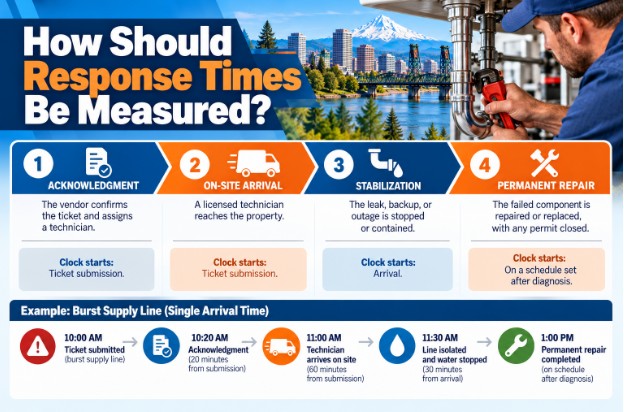
Response times should be measured in stages, and the SLA must define the event that starts each clock. No single industry standard exists, so the start points below are common examples to adopt in writing:
Take a hypothetical burst supply line: a single arrival time would hide whether the leak ran for minutes or hours after the technician walked in.
The SLA should also state which delays pause the clock, such as locked mechanical rooms, missing escorts, or parts on back order. Posting shutoff locations and access contacts in an emergency response plan shortens stabilization no matter which vendor answers.
If you’re ready to get started, call us now!
A multi-site plumbing vendor account should give every property one dispatch channel, one approval process, and site-sorted records.
| Account Feature | What It Covers | Benefit to the Portfolio |
| Site profiles | Access contacts, shutoff locations, equipment list, known problem lines | Technicians arrive prepared |
| Single dispatch channel | One phone line or portal for all sites | Every site follows the same steps |
| Not-to-exceed limits | Dollar cap a technician may spend before calling for approval | Controls spending without stalling small repairs |
| Consolidated invoicing | Invoices coded by site, building, or cost center | Simplifies owner reporting and CAM reconciliation |
| Portfolio records | Service history, photos, and permit numbers per site | Records survive staff or vendor changes |
Site profiles should record which valves actually isolate which floors. Modern Plumbing Co. maps and tests isolation valves before renovation tie-ins, since a building whose only working shutoff is at the main forces after-hours work.
Approval limits can also vary by situation, with a lower cap for routine repairs and a higher cap during an active leak. Mixed portfolios should confirm the vendor already services similar multi-family and office buildings.
Unmapped shutoffs slow every emergency. Modern Plumbing Co. offers a Portland building systems walkthrough so site profiles start from verified conditions.
The property owner and the food service operator remain legally responsible under Portland rules. A vendor can coordinate the work and keep records, but it doesn’t take over those obligations.
| Requirement | Legally Responsible | Vendor or Tester Role | Agency |
| Annual backflow test, plus retest after installation, relocation, or repair | Property owner, and the assembly owner if different | State-certified tester performs the test; vendor can schedule and track by site | Portland Water Bureau |
| Backflow test report | Property owner | Certified tester submits the report to the Water Bureau and gives the owner a copy | Portland Water Bureau |
| Grease interceptor cleaning and cleaning report | Food service establishment | Pumper cleans; a preferred pumper can file the report for the business | Bureau of Environmental Services |
| Plumbing permits for commercial work | Licensed plumbing contractor | Contractor buys the permit and performs the work | Portland Permitting & Development |
Portland City Code 21.30.320 allows the Water Bureau to discontinue water service after notifying the owner or tenant when required backflow protection is missing, poorly maintained, or untested.
Portland’s Bureau of Environmental Services sets each establishment’s cleaning schedule by establishment type, interceptor size, and discharge volume.
Managers should check who files each report against Portland’s grease interceptor cleaning rules. Modern Plumbing Co. coordinates backflow testing and documentation for commercial properties.
Property managers should compare vendors on a full year of cost by adding four figures:
A vendor with the cheaper monthly fee can still cost more per year if its emergency multiplier is higher or its exclusions are broader.
Modern Plumbing Co. offers commercial service contracts in three structures: a flat monthly fee, tiers by visit frequency, and a base fee plus time and materials. Contracts range from $200 to $2,000 per month.
Non-contract commercial work runs $75 to $150 per hour, and emergency calls bill at 1.5 to 2.5 times the standard rate. Capital replacements are typically billed separately.
Before signing, a commercial plumbing vendor should provide license numbers, current insurance certificates, sample documentation, and references from comparable properties.
Portland’s commercial plumbing permit rules require a licensed plumbing contractor to obtain the permit and perform the work when a business operates in a commercial structure.
The contractor needs an Oregon Construction Contractors Board license and a state Plumbing Business (PB) license. Managers can check the CCB number before approving a vendor.
Managers should request a redacted work order, an itemized invoice, and a photo service report, each sorted by site. A commercial plumber checklist covers insurance, references, and red flags.
What is a plumbing vendor SLA?
A plumbing vendor SLA is a written agreement that defines call priorities, response targets, coverage hours, escalation contacts, reporting, and remedies for missed targets. Property managers use it to turn a vendor’s general promise of fast service into measurable, enforceable terms.
When should the response-time clock start in a plumbing SLA?
The response-time clock starts at whatever event the SLA defines, commonly ticket submission for acknowledgment and arrival targets, and arrival for stabilization. No universal standard exists, so two vendors quoting the same target may measure different things without written definitions.
How should property managers handle plumbing vendors across multiple Portland sites?
Property managers should use one vendor account with site profiles, a single dispatch channel, not-to-exceed approval limits, and site-coded invoices. That setup gives every Portland property the same service process and keeps service records together when staff or vendors change.
What is a not-to-exceed limit in a plumbing service agreement?
A not-to-exceed limit is the dollar amount a technician may spend on a repair before stopping for approval from the property manager. Many portfolios set a lower limit for routine repairs and a higher limit during active leaks or sewage backups.
Who is responsible for backflow testing when a vendor services several buildings?
The property owner remains responsible under Portland City Code 21.30.320, along with the assembly owner if different. A vendor can schedule tests and track each assembly by site, while the certified tester submits each report to the Water Bureau and gives the owner a copy.
What licenses should a commercial plumbing vendor in Portland have?
A commercial plumbing vendor in Portland should hold an Oregon Construction Contractors Board license and a state Plumbing Business (PB) license. Portland requires a licensed plumbing contractor to buy the permit and perform plumbing work when a business operates in a commercial structure.
How can a cheaper plumbing contract cost more per year?
A cheaper plumbing contract can cost more per year if its emergency multiplier is higher, its exclusions are broader, or it bills extra visits separately. Adding base fees, extra visits, after-hours calls, and excluded work gives property managers a fair annual comparison.
What records should a plumbing vendor provide after each service call?
A plumbing vendor should provide a work order, an itemized invoice, photos, a description of the cause and repair, and any permit number. Sorting records by site helps property managers report to owners, track repeat failures, and prepare for compliance inspections.
A commercial plumbing vendor SLA works when it names priority tiers, staged response targets with defined clock starts, escalation contacts, reporting, and remedies. Multi-site Portland managers should add site profiles with verified shutoffs, approval limits, and site-coded invoices. Compliance duties stay with the owner or food service operator, and full annual cost shows each agreement’s real price.
Several buildings need one agreement that holds up in an emergency. Modern Plumbing Co. offers a consultation to scope a multi-site service contract in Portland.
Quick Links
Plumbing Services
SW Washington Service Areas
Oregon Service Areas